Young innovators harness AI to tackle Mpumalanga’s challenges
Academics
28 September 2026
By Mathipa Phishego
Student innovation took centre stage in Mpumalanga as young technology enthusiasts turned ideas into artificial intelligence-powered solutions to address some of the province’s most pressing economic and social challenges.
.jpeg) Prof Pius Owolawi of the Faculty of ICT at TUT.
The fourth Annual Mpumalanga Artificial Intelligence Student Hackathon (MAISH) 2026 has concluded, leaving behind more than winning projects and exhausted laptops. It showcased what can happen when students, universities, industry and the public sector come together to use AI to solve real-world challenges.
Prof Pius Owolawi of the Faculty of ICT at TUT.
The fourth Annual Mpumalanga Artificial Intelligence Student Hackathon (MAISH) 2026 has concluded, leaving behind more than winning projects and exhausted laptops. It showcased what can happen when students, universities, industry and the public sector come together to use AI to solve real-world challenges.
Held from 10 to 12 September 2026 at the University of Mpumalanga (UMP), the three-day hackathon brought together student hackers, academics, industry partners and public-sector stakeholders through a collaboration between the Tshwane University of Technology (TUT) and UMP.
This year’s event was held under the theme “Innovating for a Sustainable Mpumalanga: AI solutions for economic growth and social upliftment”. The theme challenged participants to consider how artificial intelligence can contribute to the development of Mpumalanga's communities and key sectors.
During the competition, student hackers developed technology-driven solutions to address challenges in areas such as mining, agriculture and public-sector services. The programme gave participants an opportunity to put their technical knowledge into practice while strengthening their skills in teamwork, problem-solving, innovation and entrepreneurship.
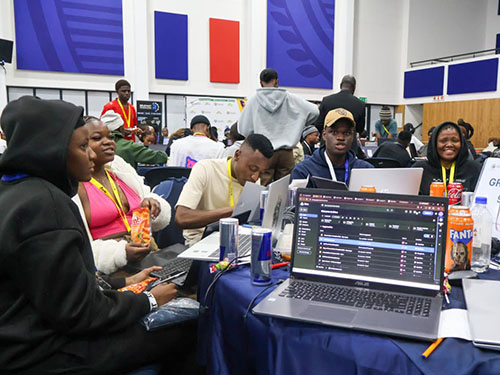 First-place winners MineLink hard at work.
Guests were welcomed by Prof Wayi-Mgwebi, Head of School at the School of Computing and Mathematical Sciences at UMP.
First-place winners MineLink hard at work.
Guests were welcomed by Prof Wayi-Mgwebi, Head of School at the School of Computing and Mathematical Sciences at UMP.
Her welcome address emphasised the importance of creating spaces where students, academics, industry, and other stakeholders can work together on technology and innovation. MAISH, she highlighted, provides students with an opportunity to move beyond theoretical learning and apply their knowledge to challenges that exist beyond the classroom.
Following an intense 60-hour coding marathon, teams presented their solutions before an adjudication panel, with four teams emerging as the leading performers. Taking first place was MineLink, with its AI-powered safety and health solution for underground mine workers. The project focused on applying AI to safety and health challenges faced by workers in underground mining, one of Mpumalanga’s key economic sectors.
Second place went to SignSure, which developed an AI-powered identity verification solution for digital signatures. The project seeks to address digital identity and verification challenges, particularly within the public sector. In third place, AgricShield AI presented an AI-powered market recovery solution for the agricultural sector.
MineGuard claimed fourth place with its intelligent mine safety and early-warning platform, demonstrating another application of AI to improve safety in the mining environment.
.jpeg) Prof Wayi-Mgwebi of the University of Mpumalanga.
The four leading projects demonstrated the ability of student hackers to apply emerging technologies to challenges affecting Mpumalanga's economy and society. While the competition had produced its winners, another important question emerged: What happens to these ideas after the hackathon?
Prof Wayi-Mgwebi of the University of Mpumalanga.
The four leading projects demonstrated the ability of student hackers to apply emerging technologies to challenges affecting Mpumalanga's economy and society. While the competition had produced its winners, another important question emerged: What happens to these ideas after the hackathon?
Reflection on the hackathon’s innovation approach, Prof Pius Owolawi, Assistant Dean for Industry Liaison, Special Projects and Work Integrated Learning at TUT's Faculty of ICT, challenged stakeholders to think beyond the traditional finish line of a hackathon. A project may win a competition, he suggested, but the bigger opportunity lies in what happens afterwards.
Do promising student projects become working prototypes? Can they develop into businesses, research outputs, industry solutions or municipal pilots? Can they attract investment and ultimately contribute to employment creation? These questions place an important spotlight on the future of projects such as MineLink, SignSure, AgricShield AI and MineGuard. The conclusion of the hackathon, therefore, may represent not an ending, but the beginning of the next phase of innovation.
.jpeg) Organisers and guests at the MAISH.
MAISH 2026 was supported by the State Information Technology Agency, Nedbank, Vodacom, the Mpumalanga Provincial Treasury and the University Capacity Development Programme.
Organisers and guests at the MAISH.
MAISH 2026 was supported by the State Information Technology Agency, Nedbank, Vodacom, the Mpumalanga Provincial Treasury and the University Capacity Development Programme.
The participation of industry and public-sector organisations strengthened the connection between student hackers and the broader technology, business and development ecosystem. It also exposed participants to challenges that extend beyond the university environment, giving them an opportunity to understand how technology can address practical needs in communities, government, and industry.
For TUT and UMP, this collaborative approach also reinforced the role universities can play in nurturing innovation and preparing students to contribute meaningfully to society and the economy.
.JPG) Organisers and guests at the MAISH.
Organisers and guests at the MAISH.