Women Leadership conference advocates for ethical, inclusive higher education
Academics
3 September 2026
By Kgothatso Monono
Ethical governance, inclusive leadership and institutional transformation shaped four days of national dialogue when higher education professionals gathered for the 2026 NASDEV Women in Leadership Conference. TUT representatives contributed leadership experience, panel insights and detailed records of discussions aimed at building equitable institutions.
 Refiloe Mthethwa and Kgothatso Monono, Delegates.
Held at the University of South Africa towards the end of August, the conference focused on the theme, “New Horizons in Leadership: Women Leading, Men Partnering for Ethical and Equitable Institutions.” The event formed part of the National Association of Student Development Professionals’ 30th anniversary programme and highlighted men’s role as active partners in advancing gender equity.
Refiloe Mthethwa and Kgothatso Monono, Delegates.
Held at the University of South Africa towards the end of August, the conference focused on the theme, “New Horizons in Leadership: Women Leading, Men Partnering for Ethical and Equitable Institutions.” The event formed part of the National Association of Student Development Professionals’ 30th anniversary programme and highlighted men’s role as active partners in advancing gender equity.
Jack Sibanyoni, NASDEV Deputy President and Extracurricular Development Practitioner in TUT’s Directorate of Extracurricular Development at the Soshanguve campuses, contributed to discussions on strengthening leadership, student development and professional practice in higher education.
Shalate Davhana, Manager in the Alumni Relations and Fundraising Advancement Office, served as a panellist and shared her professional experience during discussions on leadership and institutional development.
 Shalate Davhana, panelist
Kgothatso Monono, Faculty of ICT Journalist and Refiloe Mthethwa, Faculty of ICT Girls in Tech Co-Lead, participated as delegates and scribes. They engaged with the programme and documented key discussions, insights and proceedings.
Shalate Davhana, panelist
Kgothatso Monono, Faculty of ICT Journalist and Refiloe Mthethwa, Faculty of ICT Girls in Tech Co-Lead, participated as delegates and scribes. They engaged with the programme and documented key discussions, insights and proceedings.
“Our involvement provided an opportunity to learn from established professionals and emerging leaders from universities and TVET institutions across various provinces. We also gained exposure to national conversations on gender equity, leadership and institutional transformation,” they said.
Discussions covered leadership ethics and accountability, collaborative leadership, institutional transformation, strategic foresight, intersectionality and power dynamics. Participants also explored crisis leadership, mentorship and leadership pipelines as well as gender-based violence and institutional responsibility.
Parallel sessions allowed participants to reflect on different leadership experiences and challenges. Joint sessions encouraged dialogue and the exchange of ideas between women and men.
Following the official opening on 19 August, participants attended full-day conference sessions on 20 August. Proceedings continued on 21 August and included visits to Freedom Park and the Union Building. Final sessions and a gala dinner concluded the programme on 22 August.
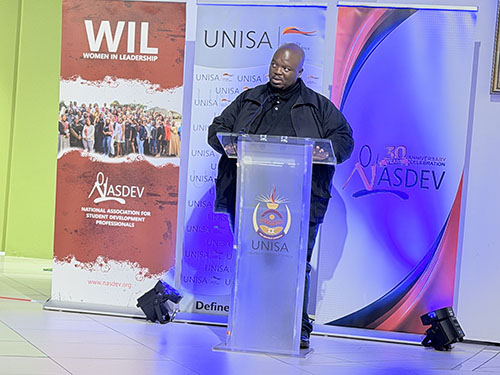 Jack Sibanyoni, NASDEV Deputy President.
The conference also encouraged networking and knowledge exchange among professionals and emerging leaders from universities and TVET institutions. Participants considered how leadership practices could respond to changing higher education realities while remaining grounded in social justice, accountability and inclusion.
Jack Sibanyoni, NASDEV Deputy President.
The conference also encouraged networking and knowledge exchange among professionals and emerging leaders from universities and TVET institutions. Participants considered how leadership practices could respond to changing higher education realities while remaining grounded in social justice, accountability and inclusion.
As NASDEV marks 30 years, the conference reflected on progress and future leadership opportunities. Its focus on women leading and men partnering reinforced collective responsibility as an important foundation for ethical and equitable higher education institutions.