TUT’s industry-focused research attracts Germany-based professional for doctoral studies
Academics
19 October 2026
By Mosima Rafapa
After years of working in Germany's mechanical engineering industry, Maren Kobusch knew exactly what she wanted from her doctoral studies: research that could address the real challenges facing manufacturers. She found that opportunity thousands of kilometres from home, at the Tshwane University of Technology’s (TUT) Department of Industrial Engineering, where applied research and industry collaboration are the mainstay.
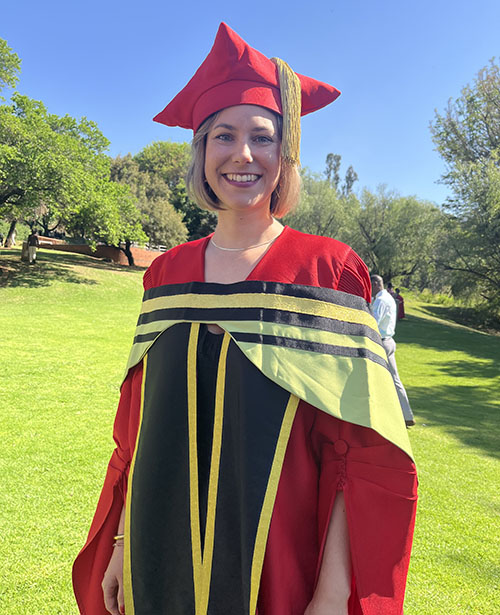 Germany-based Dr Maren Kobusch chose TUT for its applied research and industry collaboration.
Four years later, Kobusch has earned her doctorate while maintaining a full-time career as Head of Product Portfolio Management in Germany’s automation industry.
Kobusch holds a master’s degree in technology engineering and management from Osnabrück University of Applied Sciences, where she has also been teaching since 2021. Her career spans engineering, technology, business management and academia, with a particular interest in connecting industrial innovation with practical business solutions.
For Kobusch, choosing a South African university was a deliberate decision, influenced by the opportunity to pursue research that could make a meaningful contribution to industry.
"I was particularly attracted by the practice-oriented approach of the Department of Industrial Engineering and its openness to research addressing real industrial problems," she said.
"Choosing TUT was therefore not merely an academic decision. It was also a conscious decision to step outside my familiar environment and grow both professionally and personally."
Her decision was closely linked to challenges she had encountered throughout her career in machinery and plant engineering, particularly as manufacturers increasingly move beyond selling physical products towards offering integrated digital solutions and services.
"Throughout my career, I observed that many machinery manufacturers possess extensive technical expertise but face significant challenges when transforming traditional product-oriented business models into integrated product-service solutions," she explained.
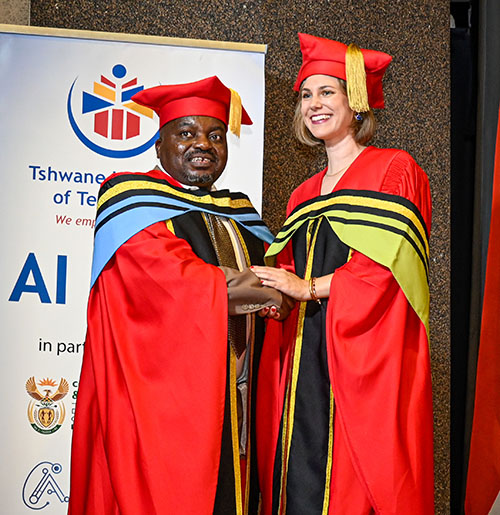 Dr Maren Kobusch with Prof Gift Nenzhelele during TUT’s Spring Graduations.
These observations inspired her doctoral thesis, “An Agile and Adaptive Process Model for Smart Product Service System Design and Transformation”.
Through her research, Kobusch developed ADEPT-PRO, a reference model designed to help manufacturing companies combine machinery, digital technologies and ongoing services while responding to changing customer requirements.
"My industry background also enabled me to engage directly with machinery manufacturers during my research, ensuring that the resulting ADEPT-PRO reference model was grounded in real industrial challenges rather than purely theoretical considerations," she said.
Her research has also influenced her approach to leadership, particularly in customer-focused innovation, cross-departmental collaboration, and product development.
Balancing a demanding leadership position with doctoral research required Kobusch to manage her time carefully. Much of her academic work took place outside normal working hours, with evenings, weekends and holidays devoted to research, data analysis and writing.
Rather than viewing her professional responsibilities and academic commitments as competing demands, she found ways to make them complement each other.
"For me, the key was to integrate my research into my professional life rather than treating both as completely separate worlds. My daily work provided continuous exposure to the industrial challenges I was investigating academically. At the same time, my research helped me reflect more systematically on practical problems and potential solutions," she explained.
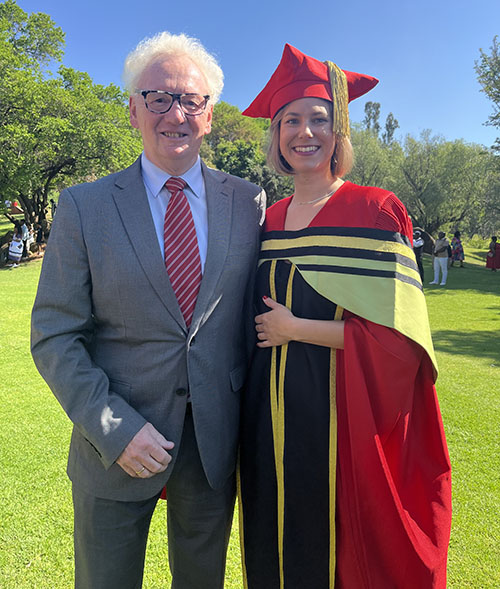 Dr Maren Kobusch with her co-supervisor, Prof Josef Gochermann.
Her supervisor, Prof Khumbulani Mpofu, a former Research Professor and former Chair of the Gibela Research Chair in Manufacturing and Skills Development at TUT, played an important role in guiding her doctoral journey.
“Maren was drawn to the department by its recognised expertise and its capacity to support doctoral research. The department’s strong track record of hosting global manufacturing conferences created a highly conducive environment for scholarly success, while the close collaboration between TUT and Osnabrück University of Applied Sciences made her decision a natural one,” said Prof Mpofu.
Kobusch also credited Prof Josef Gochermann for introducing her to South Africa, where she developed lasting academic relationships and friendships.
Another aspect of her experience that stood out was the participation of women in South Africa's academic environment.
"Coming from Germany, where women remain underrepresented in many technical disciplines, I was particularly inspired by the visibility and participation of women in the academic environment in South Africa," she said.
Looking ahead, she hopes to strengthen international collaboration between industry and academia through research and teaching, while encouraging more women to pursue careers in engineering and technology.
"Ultimately, the greatest value of a doctorate is not just the title you receive, but the perspectives you gain, the people you meet and the opportunities you create for others," she said.