TUT helps turn municipal challenges into opportunities for improvement
Academics
2 October 2026
By Mosima Rafapa
When a municipality wants to improve how it delivers services, the answers often lie in the processes happening behind the scenes. At the City of Tshwane, 130 officials are now equipped with new skills to identify problems, improve processes and find practical solutions after successfully completing a Lean Six Sigma Yellow Belt Short Learning Programme (SLP) delivered by Tshwane University of Technology.
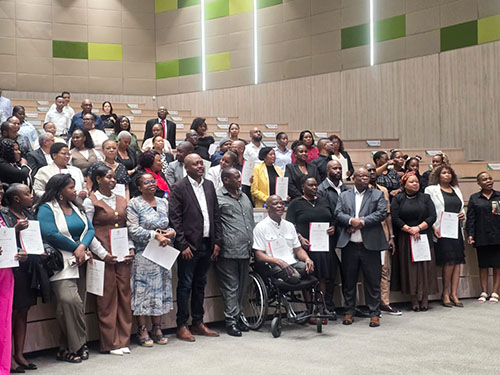 City of Tshwane officials are now equipped with new skills after successfully completing a Lean Six Sigma Yellow Belt Short Learning Programme delivered by TUT.
The training programme ran over two years, with more than 180 participants taking part and 130 successfully achieving certification as Lean Six Sigma Yellow Belt Practitioners, marking a significant milestone in the partnership between TUT and the City of Tshwane.
City of Tshwane officials are now equipped with new skills after successfully completing a Lean Six Sigma Yellow Belt Short Learning Programme delivered by TUT.
The training programme ran over two years, with more than 180 participants taking part and 130 successfully achieving certification as Lean Six Sigma Yellow Belt Practitioners, marking a significant milestone in the partnership between TUT and the City of Tshwane.
The programme was delivered by TUT’s Faculty of Engineering and the Built Environment’s Department of Industrial Engineering, through the Gibela Research Chair in Manufacturing and Skills Development for the City’s Continuous Improvement Champions. It was designed to give officials practical problem-solving, data analysis and process improvement skills that they can apply to challenges in their respective areas of work.
In his keynote address, City Manager Johann Mettler emphasised that the Lean Six Sigma programme is about far more than obtaining a certificate. He noted that the City is investing in developing officials who can serve as problem solvers, change agents and champions of continuous improvement across the organisation.
“By equipping employees with practical tools to identify inefficiencies, eliminate waste, streamline processes and improve service delivery, the programme strengthens the City’s capacity to respond effectively to the needs of residents,” said Mettler.
For the Gibela Research Chair, the achievement goes beyond the certificates awarded. It demonstrates how university expertise can be applied in the workplace to help professionals tackle real organisational challenges.
Prof Gift Nenzhelele, Gibela Research Chair in Manufacturing and Skills Development, said the initiative reflects the value of taking university knowledge beyond the classroom and applying it where it can have a practical impact.
“The programme equips participants to examine processes critically, identify inefficiencies, understand the root causes of problems and to develop evidence-based solutions. These skills can be applied across different areas of an organisation, particularly where improving efficiency and service delivery is a priority,” said Prof Nenzhelele.
The SLP was led by Prof Nenzhelele and Khutso Mashigo, a lecturer in the Department of Industrial Engineering. They developed and coordinated the programme content, ensuring that it met TUT’s institutional standards and the City’s requirements, with support from six other lecturers who contributed to the content and facilitated the training.
Mashigo has also played an important role in the broader partnership between TUT and the City. He has been instrumental in placing third-year Industrial Engineering students in the City to complete their final-year capstone projects, giving them an opportunity to gain practical experience while working on real municipal challenges.
Since 2022, more than 100 Industrial Engineering students have been placed in the City to complete their final year capstone projects as part of their Bachelor of Engineering Technology in Industrial Engineering qualification.
Prof Nenzhelele said the partnership gives students an opportunity to take their engineering knowledge into the workplace while exposing the City to fresh ideas and emerging talent.
Dr Isaac Tlhabadira, Assistant Dean for Special Projects, Work Integrated Learning and Community Engagements, said the partnership demonstrates the value of connecting university knowledge with real-world challenges. He said it also reflects TUT’s commitment to ensuring that learning extends beyond the university environment and contributes to the communities and organisations it serves.
“Through initiatives such as the student capstone projects and the Lean Six Sigma programme, we are creating opportunities for knowledge to move in both directions. Our students learn from the realities of the workplace, while professionals gain access to new ideas, tools and skills that can help them address challenges in their own environments. That connection is important in building graduates who are ready to contribute, strengthening the impact of the university’s expertise beyond the classroom,” said Dr Tlhabadira.