TUT collaboration turns creative vision into commercial glass prototypes
Academics
16 October 2026
What happens when the creative possibilities of glass meet the technical demands of functional lighting design? A collaborative project between the Tshwane University of Technology’s (TUT) Departments of Fine & Studio Arts and Interior Design challenged students to answer this through practice — developing commercially viable luminaire concepts and taking selected designs from technical resolution through to full-scale prototyping at Ngwenya Glass in Eswatini.
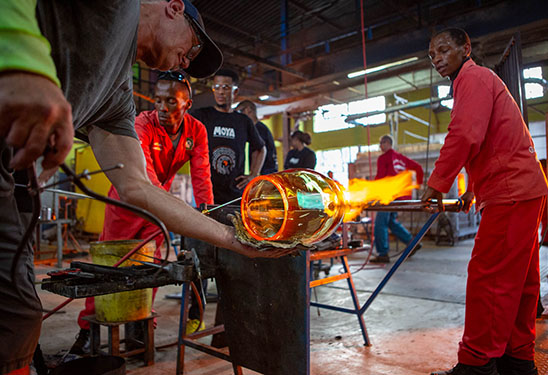 USA-based glass artist Rob Stern and the Ngwenya glass team work on The Homestead Pendant Light designed by Palesa Phake and Welcome Shiba. Photos: Lars and Elin Hauklien
The Ngwenya Luminaire Design Project paired senior Fine & Studio Arts students specialising in glass with Interior Design students, bringing together complementary knowledge of material, making, function and technical design. Eleven interdisciplinary student pairs responded to an industry brief developed in collaboration with Ngwenya Glass, which required them to create lighting that explored the expressive qualities of hand-blown recycled glass while addressing the practical constraints of manufacture.
USA-based glass artist Rob Stern and the Ngwenya glass team work on The Homestead Pendant Light designed by Palesa Phake and Welcome Shiba. Photos: Lars and Elin Hauklien
The Ngwenya Luminaire Design Project paired senior Fine & Studio Arts students specialising in glass with Interior Design students, bringing together complementary knowledge of material, making, function and technical design. Eleven interdisciplinary student pairs responded to an industry brief developed in collaboration with Ngwenya Glass, which required them to create lighting that explored the expressive qualities of hand-blown recycled glass while addressing the practical constraints of manufacture.
The challenge extended beyond designing an attractive light. Students had to consider the behaviour and limitations of recycled glass, glass-blowing techniques, lighting components, dimensions, structural connections, safety, production time, repeatability and commercial viability. Interior Design students contributed knowledge of lighting, spatial application, technical detailing and product specification, while Fine & Studio Arts students brought specialist understanding of glass, making processes and material behaviour. Together, the pairs had to negotiate their ideas and develop a shared design response.
Glass Studio lecturer, Caitlin Greenberg, explained that “Interdisciplinary collaboration is vital because each discipline brings unique strengths. By combining these through learning by making, students can create outcomes beyond what either discipline could achieve alone, while connecting their learning to professional glass practice.”
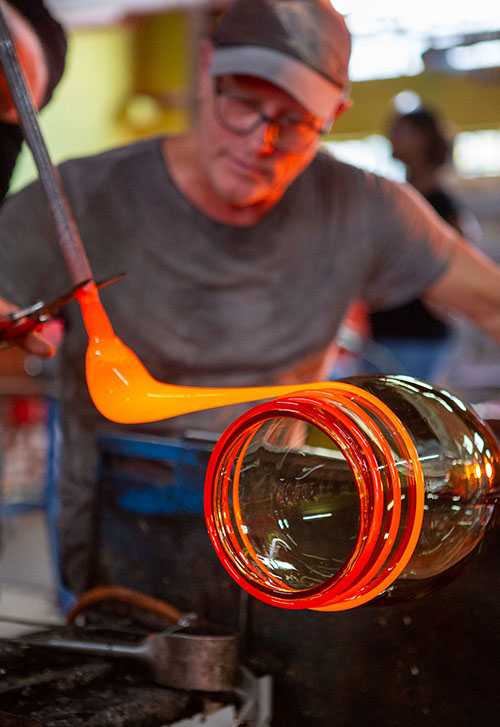 Photos: Lars and Elin Hauklien
The resulting concepts drew on African traditions, cultural narratives and the natural environment. Symphony of Light, for example, reinterpreted the calabash through a cluster of hand-blown forms, while Homestead drew on the traditional Swazi homestead and communal making. Lisakhanya explored the rhythm of traditional Zulu love-letter beadwork and the texture of African soil, while other concepts responded to the Impala Lily, wildlife conservation and the relationship between nature and contemporary living. Across the projects, cultural references were not treated simply as decorative. Students explored how narrative could influence form, texture, material, light quality and function while still producing designs suitable for contemporary interiors and potential commercial manufacture.
Photos: Lars and Elin Hauklien
The resulting concepts drew on African traditions, cultural narratives and the natural environment. Symphony of Light, for example, reinterpreted the calabash through a cluster of hand-blown forms, while Homestead drew on the traditional Swazi homestead and communal making. Lisakhanya explored the rhythm of traditional Zulu love-letter beadwork and the texture of African soil, while other concepts responded to the Impala Lily, wildlife conservation and the relationship between nature and contemporary living. Across the projects, cultural references were not treated simply as decorative. Students explored how narrative could influence form, texture, material, light quality and function while still producing designs suitable for contemporary interiors and potential commercial manufacture.
From the eleven proposals, six designs were selected to move from concept to prototype at the Ngwenya Glass factory. Students travelled to Eswatini with their designs and technical drawings and worked directly with experienced Ngwenya glassmakers to translate their ideas into physical objects.
For the students, this process exposed aspects of design that cannot be fully understood on paper. The behaviour of molten glass, production time, dimensional limitations, consistency and the inherent variation of hand-blown production became immediate design considerations. Prototyping, therefore, became an iterative process of communicating, testing and adapting ideas in response to the material and manufacturing environment.
Interior Design lecturer, Inge Weber, explained that “Taking a design from the classroom into production is an important part of the students’ learning. It showed them that the final product is shaped by a few variables. The variables include their idea, the material, the maker’s skills and the realities of the manufacturing process. Working through these aspects helped the students become more adaptable designers and understand the value of collaboration in bringing a concept to life.”
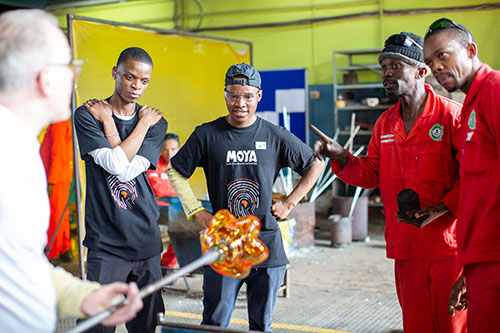 Students, Sifiso Shangase (Interior Design) and Kabelo Motsamai (Glass Studio), look on as Edmond Byrne from the UK works with the Ngwenya Glass team to produce their design, the Khula Table Lamp. Photo: Lars and Elin Hauklien
The prototyping coincided with the Ngwenya component of Glass Safari 2026, hosted in partnership with the MOYA African Glass Network. This placed students in a professional environment alongside Ngwenya artisans and international glass practitioners from Australia, Belgium, the United Kingdom and the United States. Rather than simply observing professional practice, students were able to participate in a shared studio environment where technical knowledge, ideas and approaches to making were exchanged through practice.
Students, Sifiso Shangase (Interior Design) and Kabelo Motsamai (Glass Studio), look on as Edmond Byrne from the UK works with the Ngwenya Glass team to produce their design, the Khula Table Lamp. Photo: Lars and Elin Hauklien
The prototyping coincided with the Ngwenya component of Glass Safari 2026, hosted in partnership with the MOYA African Glass Network. This placed students in a professional environment alongside Ngwenya artisans and international glass practitioners from Australia, Belgium, the United Kingdom and the United States. Rather than simply observing professional practice, students were able to participate in a shared studio environment where technical knowledge, ideas and approaches to making were exchanged through practice.
The learning experience continued beyond the factory as all eleven student designs were publicly presented in a poster exhibition at the Pretoria Arts Association, alongside the six manufactured prototypes. Further public showings of the work included the 100% Fresh exhibition at Decorex Johannesburg, alongside work from the Academic Institute of Excellence (AIE), the FAD Arts Festival and the Artivism and USAf conferences. These exhibits enabled students to communicate their research, design development and technical thinking to audiences beyond the university studio.
On reflection of the project, Interior Design Student, Zaworita Sekepe shared that “The concept ‘Symphony of Light’ had an organic language that gave the design an elegant look that seemed simple to execute, but prototyping revealed the amount of skill, technique and dedication needed to achieve that elegance. The process showed the importance of exploring and redefining practices to achieve the desired outcome, and sometimes that means being adaptable and letting ideas go, especially when working with a material as fragile as glass. Seeing the development and having a final product to exhibit fuels the aspiration to create more in the future.”
Glass Studio Student, Tyrone Mudzanani, also shared that “Seeing ‘Symphony of Light’ presented in public spaces was an exciting, proud moment for me. It was also different from seeing the work in studio because I could experience how glass, light and space work together and how viewers respond to it. As an upcoming artist and a designer, this exposure gives me confidence and it shows me that the ideas I develop within my practice can also resonate with a lot of people. Lastly, it also motivates me to keep on experimenting with glass and continue developing my artistic identity and my professional career.”
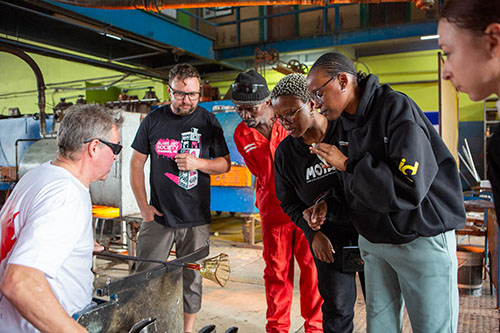 Thobile Mbatha (Interior Design) and Mohaleditwe Halle Gumede (Glass Studio) oversee the forming of their glass components at the Ngwenya Glass Studio, with artists Tim Shaw from Australia and Lancelot Fraser from the USA. Photo: Lars and Elin Hauklien
Inge Newport, HoD for the Department of Interior Design, expressed that “This collaboration demonstrates what becomes possible when different departments and industry partners contribute expertise to a shared learning experience. Students responded to a real industry brief, worked across disciplinary boundaries, resolved their ideas technically, encountered the realities of manufacture and saw their work move into public and professional exhibition contexts, making for a rich learning experience.”
Thobile Mbatha (Interior Design) and Mohaleditwe Halle Gumede (Glass Studio) oversee the forming of their glass components at the Ngwenya Glass Studio, with artists Tim Shaw from Australia and Lancelot Fraser from the USA. Photo: Lars and Elin Hauklien
Inge Newport, HoD for the Department of Interior Design, expressed that “This collaboration demonstrates what becomes possible when different departments and industry partners contribute expertise to a shared learning experience. Students responded to a real industry brief, worked across disciplinary boundaries, resolved their ideas technically, encountered the realities of manufacture and saw their work move into public and professional exhibition contexts, making for a rich learning experience.”
The six selected student pairings were Botho Mokgethwa and Thandoluhle Tembe; Thobile Mbatha and Mohaleditwe Halle Gumede; Mpho Masindi and Aphiwe Phumulani Dladla; Palesa Phake and Welcome Shiba; Sifiso Shangase and Kabelo Motsamai; and Zaworita Sekepe and Tyrone Mudzanani.
For more exciting updates, follow the Department of Interior Design on:
LinkedIn: https://www.linkedin.com/in/tut-interior-design-department-623646295/
Facebook: https://www.facebook.com/profile.php?id=61552360494367
Instagram: https://www.instagram.com/tut_artsidesign/?hl=en
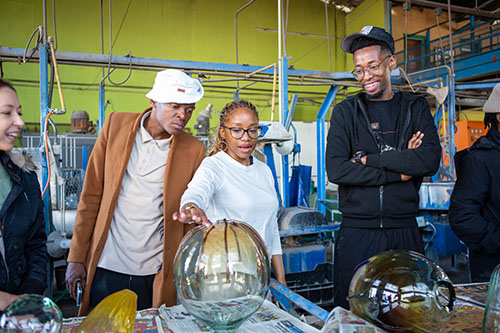 Welcome Shiba (Glass Studio), Palesa Phake and Asanda Mntambo (Interior Design), assess one of the prototype components developed for the Homestead pendant light at the Ngwenya Glass Studio. Photo: Lars and Elin Hauklien
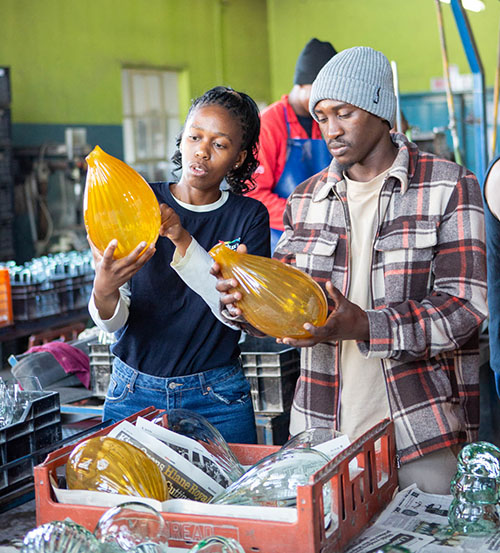 Zaworita Sekepe (Interior Design) and Tyrone Mudzanani (Glass Studio) assess their glass prototype components before they leave the Ngwenya Glass Studio in Eswatini. Photo: Lars and Elin Hauklien
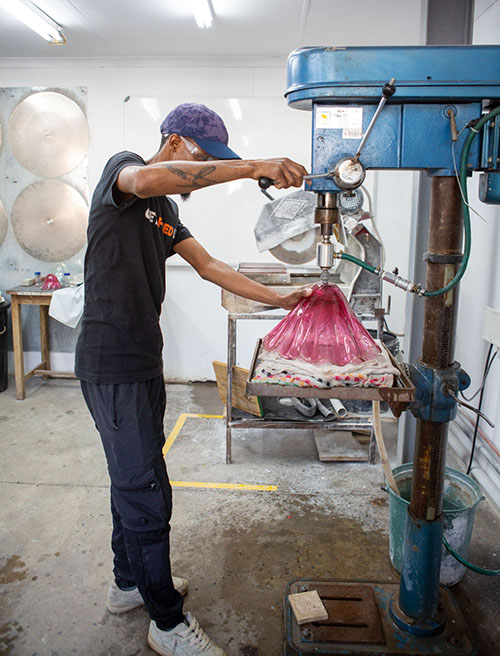 Thato Kokana (Glass Studio) works on the technical assembly of the Khula pendant light at the FAD campus. Photo: Lars and Elin Hauklien
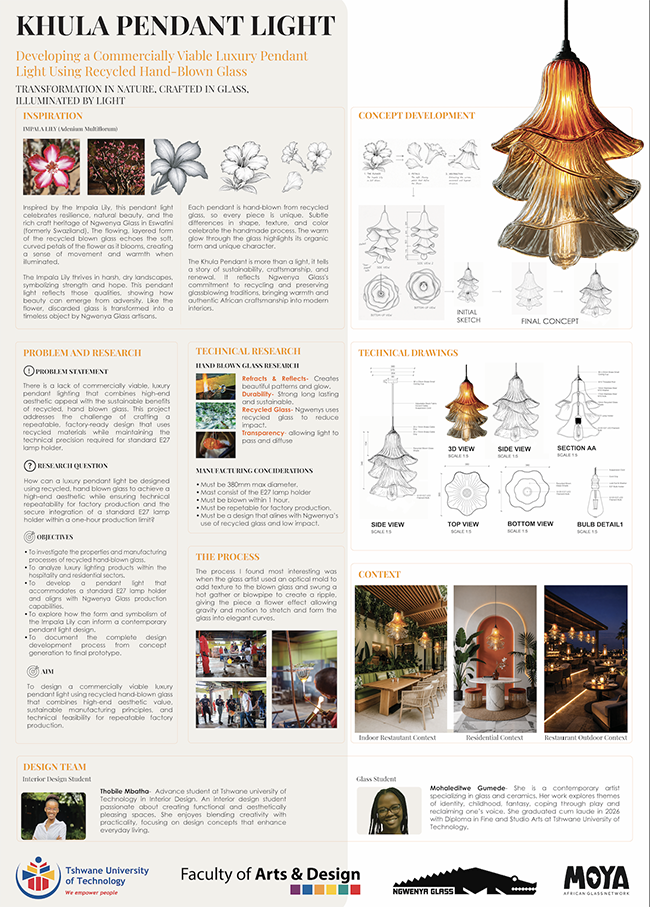 A research poster developed by students to share their concepts and technical details. Board by Thobile Mbatha (Interior Design) and Mohaleditwe Halle Gumede (Glass Studio).
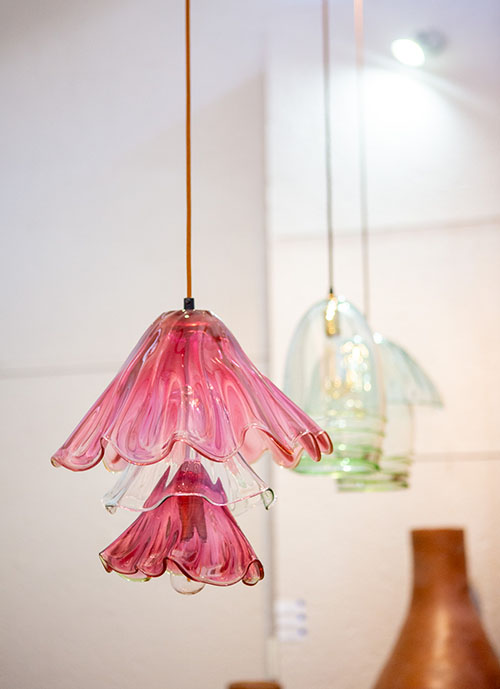 Designs on display at the Pretoria Association of the Arts. Front: Khula Pendant Light by Thobile Mbatha (Interior Design) and Mohaleditwe Halle Gumede (Glass Studio). Back: The Homestead Pendant Light by Palesa Phake and Welcome Shiba. Photo: Lars and Elin Hauklien
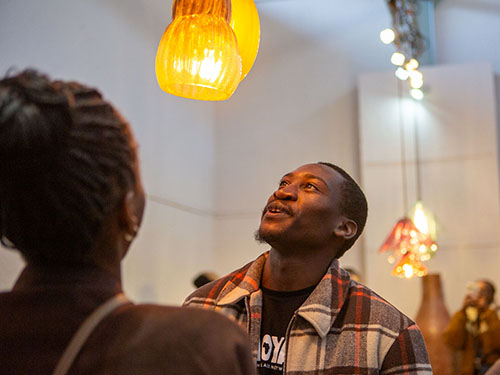 Tyrone Mudzanani (Glass Studio) and Zaworita Sekepe (Interior Design) admire their design, The Calabash – Symphony of Light pendant, on display at the Association of the Arts. Photo: Mduduzi Khumalo
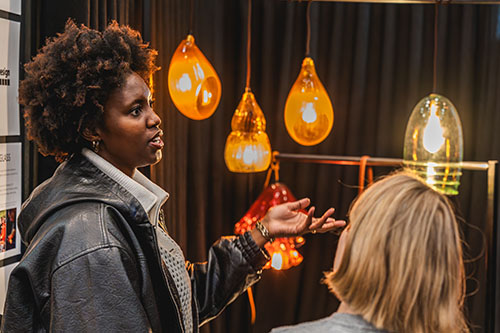 Interior Design Student, Botho Mokgethwa, engages with visitors at Decorex. Photo: Didintle Morudu