TUT and Gauteng Human Settlements join forces to tackle housing challenges
Academics
13 October 2026
By Mosima Rafapa
Housing challenges in Gauteng will be placed under the research spotlight as the Tshwane University of Technology (TUT) and the Gauteng Department of Human Settlements (GDHS) join forces to examine policy gaps, improve planning and find practical solutions to the province’s housing needs.
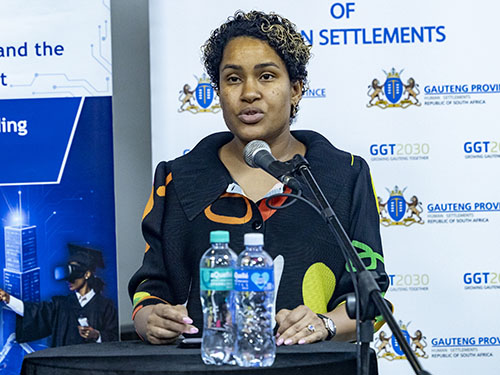 Gauteng MEC for Human Settlements, Tasneem Motara, delivers her keynote address at the TUT–GDHS MoU launch.
The two institutions officially launched a five-year Memorandum of Understanding (MoU) on 6 October 2026, marking a partnership that will draw on the University's research expertise to support sustainable human settlements.
Gauteng MEC for Human Settlements, Tasneem Motara, delivers her keynote address at the TUT–GDHS MoU launch.
The two institutions officially launched a five-year Memorandum of Understanding (MoU) on 6 October 2026, marking a partnership that will draw on the University's research expertise to support sustainable human settlements.
Housed within TUT's Faculty of Engineering and the Built Environment (FEBE) in the Department of Building Sciences, the partnership was launched in the presence of Gauteng MEC for Human Settlements Tasneem Motara, the department’s Head of Department, Puleng Gadebe-Mabasa, Director for Policy and Research, Mugabe Ratshikuni, and other stakeholders.
A panel discussion themed “From Research to Delivery: Building a Partnership for Sustainable Human Settlements” examined pressing housing challenges, outdated policies and delivery gaps, focusing on how research could inform government decisions and bring visible improvements to Gauteng’s communities.
In her keynote address, MEC Motara emphasised that housing delivery goes beyond building houses. It is about giving families stability, security and access to opportunities.
Motara acknowledged the lasting effects of historical spatial planning, which left many communities far from economic opportunities, and stressed the need for cooperation between government, universities and communities.
“TUT’s emphasis on applied research makes this relationship especially valuable. It offers a strong connection between academic enquiry and practical challenges,” she said.
She also urged the government to embrace research findings that may challenge existing approaches.
“Government must be open to new thinking. We need the confidence to examine our own approaches and consider evidence that may ask us to do things differently,” she added.
 FEBE Executive Dean, Prof Mxolisi Shongwe, highlights the role of research and innovation in addressing Gauteng's housing challenges.
FEBE Executive Dean, Prof Mxolisi Shongwe, highlighted challenges including rapid urbanisation, ageing infrastructure, informal settlements requiring upgrading and climate vulnerability.
FEBE Executive Dean, Prof Mxolisi Shongwe, highlights the role of research and innovation in addressing Gauteng's housing challenges.
FEBE Executive Dean, Prof Mxolisi Shongwe, highlighted challenges including rapid urbanisation, ageing infrastructure, informal settlements requiring upgrading and climate vulnerability.
“Government cannot do it alone, and universities cannot remain isolated ivory towers. Through this MoU, TUT and the Gauteng Department of Human Settlements commit to bridging the gap between scientific inquiry and real-world impact,” he said.
Prof Shongwe said FEBE’s expertise in sustainable building materials, energy-efficient construction and digital technologies could contribute to affordable housing and improved settlement planning.
Head of the Department of Building Sciences, Dr Rudzani Muthelo, said the partnership would allow the department to apply its expertise to housing challenges while exposing students to real projects.
“Our department has expertise in construction, building technologies and the management of the built environment. Through this partnership, we want to use that knowledge to help identify challenges in housing delivery and explore practical, affordable solutions. We also want our students to be part of this work, gaining exposure to real projects while contributing to the communities they will one day serve,” he said.
 Head of the Department of Building Sciences, Dr Rudzani Muthelo, who will coordinate TUT's implementation of the partnership.
Dr Muthelo, who will serve as TUT's primary implementation representative, added that the focus would be on ensuring that the partnership moves beyond the signing of the agreement to projects that deliver measurable results.
Head of the Department of Building Sciences, Dr Rudzani Muthelo, who will coordinate TUT's implementation of the partnership.
Dr Muthelo, who will serve as TUT's primary implementation representative, added that the focus would be on ensuring that the partnership moves beyond the signing of the agreement to projects that deliver measurable results.
“We don’t want this MoU to remain a document on paper. We want to see research projects taking shape, recommendations being put into practice and communities benefiting from the work we do together,” he added.