The TUT Mission in Fanonian Perspective: The Relentless Pursuit of Academic Excellence
AcademicsDesk of the VC - Prof Tinyiko Maluleke
30 October 2026
By Prof Tinyiko Maluleke, Vice-Chancellor and Principal: Tshwane University of Technology
TUT Academic Excellence Awards Keynote; 28 October 2026, Menlyn, Pretoria
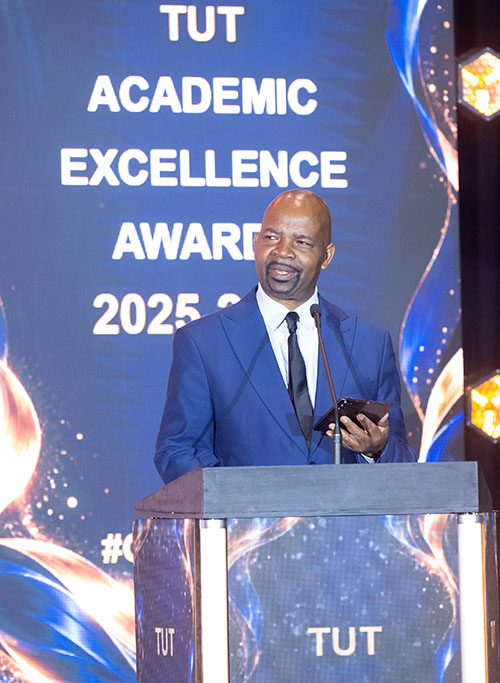 Stepping out of the shadows of obscurity
Every country has its halls of fame and its academies of the science - even though these may take different shapes and forms. Every society has its array of artists, thinkers, knowledge makers, visionaries, and repositories of wisdom – even though some of these are sung, while many remain largely unsung. The bearers of these talents and accolades are young and they are old; they are male and they are female and they are LGBTI+. Every generation owes a great debt to its innovative leaders of thought.
We gather tonight, to pay homage to TUT’s best academics. We have come to adorn them with the TUT mantle of excellence.
In his inimitable classic, The Wretched of the Earth, Frantz Fanon memorably suggests that: “every generation must, out of relative obscurity, discover its mission, fulfil it, or betray it.” Amongst others, Fanon is suggesting that each generation has the responsibility to bid farewell to its own sense of innocence, and step out of the shadows of its obscurity, thus to rise above its sense of inexperience.
Fanon is not exactly calling for each generation to pull itself up by its own bootstraps. Writing in the early 60s as a liberation psychiatrist, no one was more aware of the physical, mental and the spiritual shackles of the ‘postcolony’ – an entity about which Achille Mbembe was to elaborate most eloquently, several decades later - in his book On the Postcolony. To misquote the title of a Negro Spiritual song made famous by, amongst others, Louis Armstrong (nobody knows the troubles I’ve seen); nobody knew the colonial troubles that Africans had seen more than Frantz Fanon. Indeed, few people were as steeped – literally - in the African struggle against colonialism than Frantz Fanon. He was in the trenches during the Algerian war of liberation against the French.
Fanon knew the great odds that kept Africans from emerging out of historical obscurity. In Fanon’s diagnosis, which was in line with, if not based on, the observation made by Pan-Africanist Marcus Garvey, the greatest devastation of colonialism lay not it what it did to the body, but rather on the harm it visited upon the mind. And yet, Fanon insisted that, even among the victims of colonialism, “every generation must, out of relative obscurity, discover its mission, fulfil it, or betray it. The people he described as les damnés de la terre, aptly and poetically translated as the wretched of the earth were no exception. They too, were called upon to rebel against apathy and nihilism. They too have an obligation to strive towards the freedom they had never known or experienced.
Beyond Kundera
In his book The Art of the Novel, Milan Kundera has described lack of experience “as a quality of the human condition”. He goes on to say, “we are born one time only; we can never start (a new) life equipped with the experience we’ve gained from a previous one. We leave childhood without knowing what youth is, we marry without knowing what it is to be married, and even when we enter old age, we don’t know what it is we’re heading for … .”
Fair enough, but Kundera was a tad too European in his outlook. Indeed, his book is an ode to “the European novel” and the European novelists.
Accordingly Kundera is interested in the work of Frantz Kafka and not the work of Frantz Fanon; he is partial to the work of Leo Tolstoy (Anna Karenina) and not that of Sol Plaatje (Mhudi); Kundera is fascinated by the work Migeul de Cervantes (Don Quixote) whom he regards as the true and original novelist and not Thomas Mofolo (Traveller from the East); Kundera reveres Denis Diderot’s (Jacque le Fataliste) and not Wole Wole Soyinka (Death and the King’s Horsemen). Conspicuous but its absence in Milan Kundera’s book is the massive contribution of the European colonies – their lands, rivers, mountains, minerals, and peoples - to the form and the content European novel. Talk about knowledge originators who are sung over against those who are unsung!
Afterall, is Denis Diderot’s Jacques the Fatalist not about the unusual adventures of a master and his slave? The slave in the book is unlikely to be a Caucasian male. And how would Joseph Conrad have ever dreamt up his infamous book “the heart of darkness” if he never heard tales of Europeans sailing their colonial boats along the Congo river? How would Karen Blixen ever have written her “Out of Africa” if she had not experienced life at the foot of Kenya’s Ngong Hills? And; is Rudyard Kipling, winner of the Nobel Prize in Literature (1907), he who authored the infamous poem, the white man’s burden, amongst other poems and works of fiction; is he possible at all, without the influence of colonial India, where he was born?
But, like a typical professor, I am digressing, ever so slightly if also so blatantly.
The Summer Within
To return to my proposition; every generation must create a repository of data and it must produce sets of knowledges that are crucial for sense-making, the sustenance of humanity, the planet and all life-forms in it.
The Fanonian challenge is as simple as it is unavoidable: Every generation ought to be able both to pose, and to answer for itself, the question: “What is the mission of our generation”? Contrary to popular belief, this is not a to be answered only on hindsight. Answering the question of “what the mission of our generation is” is the first act of the self-discovery that enables the discovery of generational missions. It is not the epilogue; it is the prologue and the front matter of the books of our lives. It defines the trajectory of our endeavours and becomes the measure of our lives.
Unless we can seriously pose to ourselves this question – what is the mission of our generation - and unless our generation can answer the same question and do so with what Adrian Gore, in his book The Four Principles calls a sense of “focussed urgency” and a dose of “outrageous optimism”, we are on course to failing both the previous generations and the generations that will come after us. [See my own review of Adrian Gore’s book].
Why is optimism important? It was the great Algerian writer and Nobel Prize in literature winner, Albert Camus who in his Retour à Tipasa, suggested that au milieu de l’ihiver, j’apprenais enfin qu’il y avait en moi in ete invincible (“in the midst of winter, I found within me, an invincible summer”.
To reclaim its generational mission, each country, each institution, and each individual must find and connect with the summer within, the summer of which Camus spoke. In the Golfing language of Adrian Gore, we must stay focussed on the hole beyond the lake over which we wish to hit the ball. While others swim in the sea of pessimism, we must stay focussed on wondrously clear daybreak of optimism, which is sadly invisible to the pessimist. And why is a sense of focused urgency important? Because every generation and every individual has only a limited and very small window of time to make an impact.
So; what indeed, is the mission of our generation! What, indeed is the mission of TUT in this country and in the world, at this time? What is the mission of the TUT academic and researcher? How does she define the trajectory of her impact she wishes to have?
Behind these questions is a quest to understand that which what only a specific generation, institution, team of researchers, individual academic can do in a way no one else can in the whole world.
And here’s the thing: No generation can discover its mission, unless and until the very best among its knowledge makers, its inventers of hope, its weavers of dreams, its builders of knowledge universes and its enhancers of life; step out of the shadows of obscurity, discover their mission, fulfil it, or betray it. Oh, the shadows of obscurity! They are external and they are internal. The role of the shadows of obscurity is to extinguish ambition and to annihilate academic self-esteem, from individuals and institutions alike.
Like the best of their peers in this country and beyond, TUT researchers pursue excellence in response to the human vocation of knowledge as the very basis of human survival, from one generation to the next. Without knowledge origination, there is no past, no present and certainly no future for humanity and the natural environment. Without the production of new ideas, there is no leadership.
The TUT Mission
No generational mission can be defined outside the realm of the creation of knowledge creation and the pursuit of the scientific method. This is what distinguishes academic leadership from the rest. There is no generational mission that can be found outside the realm of ideas and the generation thereof. Indeed, leadership is basically the ability to produce fresh ideas that forces us to step out of the shadows of obscurity.
For ours or any generation to discover its mission, a knowledgeable and ethical leadership, deeply committed to excellence must be forged in our midst so that it may push us out of the shadows of obscurity and mediocrity. Now that, is the business of a university such as the Tshwane University of Technology. At TUT we are on the move, from obscurity to clarity, from good to great. Hence, we meet tonight to celebrate the very best of TUT, they who have discovered their generational mission and are in the process of gloriously fulfilling it. The TUT academics and researchers we shall honour tonight unequivocally defined and laid out its generational mission.
Mark Twain may not have been too far off the mark when he allegedly said, “the two most important days in your life are; the day you were born, and the day you found out why”. It is a scary thought, but it is probably true that far too many people find out too late, as to why they were born too late. Some never do. It is calamitous enough for an individual never to find out their purpose, but the consequences of whole institutions and whole generations failing to find out why they were established, are too ghastly to contemplate. It is a national tragedy in the making. Maybe we are in the middle of such a national, continental, and global crisis. God forbid!
Were Frantz Fanon to come back and inquire, “hey TUT are your stepping out of the shadows of your relative obscurity?” TUT will respond, in the confident voice of the great Maya Angelou, saying,
They may write me down in history with their bitter twisted lies,
They may have attempted to trod me down and paint me in the colour of dirt and failure;
but like dust, I, TUT am rising.
And still, I rise!
I have left behind the history of chronic instability, I am bidding farewell to failed and failing infrastructure
I have removed the academic project from the bottom left and I have firmly put it at the very center of everything I am and everything I do.
Over the past five to ten years, I have been working hard to root out every distraction, every bottleneck and every impediment that has been preventing me from performing optimally – on all key metrics.
Now there is a soft rain of research outputs, books, creative outputs, patents, discoveries, and postgraduate graduations. Now I am entrepreneuring!
While others are still dreaming of the good old days of a hundred years ago, TUT is firmly focussed in the present and in the future – the future of work. Whereas in many universities entrepreneur is a noun and an optional extra, at TUT entrepreneur is a verb, it is something we do. We are entreprenuering the future together. Don’t you see the sparks of innovation that are coming out of our campuses? When Moki Makura wrote her book, Africa’s greatest entrepreneurs, TUT was only four years old. She should have waited a minute! Had she waited her book would not have comprised only of 16 male entrepreneurs! It would have had several dozens more entrepreneurs – mostly produced and inspired by TUT.
Were Frantz Fanon to ask TUT: What is the mission of your current generation of scholars and researchers? We shall say, without any equivocation that, our generational mission is to entrepreneur the future of work. For us entrepreneurship is not a set of narrowly defined set of strategies and tactics which may be acquired during a weekend Short Learning Programme. For us entrepreneurship is a constellation of comprehensive, crosscutting skills, crafts and instincts – the graduate attribute this country and this century have yet to fully appreciate. That’s where we at TUT are at, and that’s where we are going with this. TUT is that institution that has discovered why it exists, and it is ready to fire in all cylinders, towards an entrepreneurial future of work. TUT is that university that only TUT can be.
It is therefore with a sense of immense pride and pleasure that I invite you tonight to join me in congratulating the men and the women who have stepped up and stepped forward to drive TUT towards its generational mission, at this point in its 22-year-old history. Come, meet the scholars who exude Adrian Gore’s “outrageous optimism”, scholars with a “focussed sense of urgency”.
So come, join me in recognising excellence in its purest form – academic excellence. Come, let us celebrate the academically excellent individuals who, over time, will have an exponential influence on the greatest number of people across the institution and across society, space and time. Tonight we meet TUT’s Albert Einsteins, Toni Morrisons, Hamilton Nakis, Tebello Nyokongs, JM Coetzees, and Chimamanda Ngozi Adichies. Come let us adorn our best academics and researchers with the red and blue mantle of TUT excellence.
And so, if Mark Twain were to come back and ask, “hey TUT, we know about the day you were born, but please tell us about the day you found out why, we shall answer yet again, in Maya Angelou’s voice, saying.
We have left behind nights of terror, instability, fear and being put under administration
We have been reborn into a daybreak that is wondrously clear
We are dancing into the future of work
We are entrepreneuring from good to great
And still, we rise
We rise
We rise!