Lecturer’s doctorate challenges how architecture is taught in African universities
Academics
15 October 2026
By Mosima Rafapa
Growing up in Tembisa, Jabu Makhubu never imagined that watching beautiful homes on the television programme Top Billing would spark an interest that would eventually lead him to challenge the way architecture is taught in African universities.
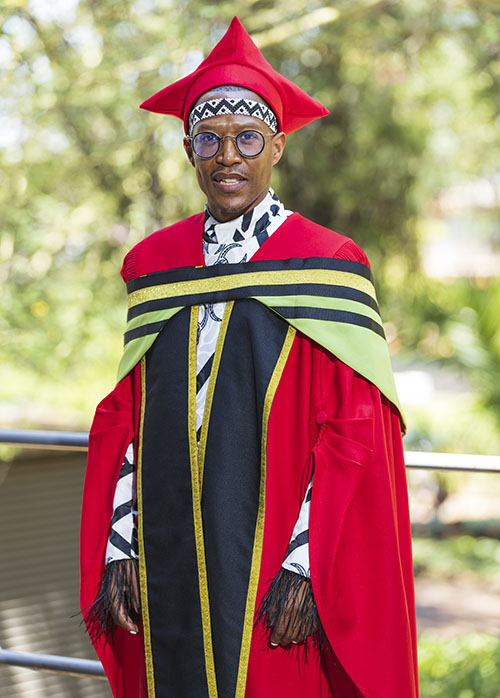 Dr Jabu Absalom Makhubu celebrates earning his Doctor of Architecture.
On 13 October 2026, Makhubu was conferred with a Doctor of Architecture during the Tshwane University of Technology’s (TUT) Faculty of Engineering and the Built Environment (FEBE) Spring Graduations. He is among 71 doctoral graduates being conferred with their qualifications during the University’s ongoing Spring Graduations.
Dr Jabu Absalom Makhubu celebrates earning his Doctor of Architecture.
On 13 October 2026, Makhubu was conferred with a Doctor of Architecture during the Tshwane University of Technology’s (TUT) Faculty of Engineering and the Built Environment (FEBE) Spring Graduations. He is among 71 doctoral graduates being conferred with their qualifications during the University’s ongoing Spring Graduations.
Now a lecturer at the University of the Witwatersrand’s School of Architecture and Planning, Makhubu grew up largely under the care of his grandmother, whose influence remains central to his life.
“I grew up surrounded by love, joy and a sense of belonging,” he recalled.
That sense of belonging, however, was missing from his undergraduate architectural education, where he felt that his background and lived experiences were not valued.
“My undergraduate architectural training did not value my background or lived experience. As an academic, my goal is to widen the frames of reference we use to legitimise knowledge,” he explained.
His interest in architecture began with Top Billing, which introduced him to homes and environments far removed from his immediate surroundings. Drawn to the people behind these designs, and with an aptitude for mathematics and science, he pursued architecture.
He later worked in architectural and urban design practices, contributing to projects including the Sci-Bono Science Building, Metrolink and Morris Isaacson Music School.
However, the limitations he encountered in professional practice eventually pushed him towards academia.
“Academia was a space that challenged me, inspired me, and gave me a sense of belonging I only felt when I was at my grandmother’s house,” he said.
He joined the University of Johannesburg (UJ) as a lecturer in 2014 before moving to Wits in 2023.
His doctoral thesis, Radical Praxis: Examining the Shifts in Architectural Pedagogic Discourse on Contemporary Urbanisms in Africa at the University of Johannesburg, investigates how architectural education can better respond to African realities.
His research found that efforts to transform architectural teaching are often driven by individual lecturers, with limited institutional support.
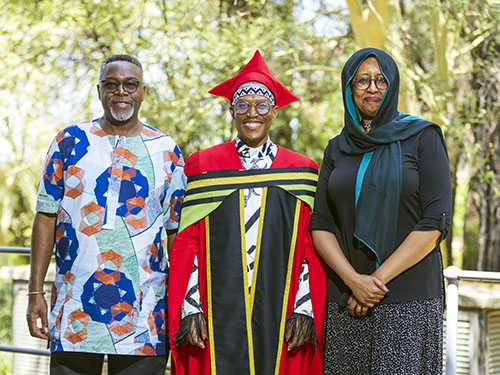 Dr Makhubu shares his proud moment with supervisors Dr Finzi Saidi and Prof Amira Osman who guided him throughout his doctoral journey.
He proposes an approach that recognises students’ and lecturers’ lived experiences as legitimate sources of knowledge, encouraging learning through design, dialogue and critical reflection.
Dr Makhubu shares his proud moment with supervisors Dr Finzi Saidi and Prof Amira Osman who guided him throughout his doctoral journey.
He proposes an approach that recognises students’ and lecturers’ lived experiences as legitimate sources of knowledge, encouraging learning through design, dialogue and critical reflection.
Makhubu chose TUT’s Doctor of Architecture programme because of its practice-based research approach, which allowed him to test his findings through teaching.
His research was supervised by Prof Amira Osman, the South African Research Chair Initiative Chairholder in Spatial Transformation at TUT, alongside co-supervisor Dr Finzi Saidi.
He credits their guidance and TUT’s research support initiatives for helping him navigate the demands of doctoral study.
“As his supervisor, I find that Makhubu’s work is an important contribution to a broader decolonial agenda. He brings knowledge, experiences and contexts that were previously underrepresented and undermined into the academic realm and gives them academic legitimacy,” said Prof Osman.
“Future students may now build on what this work has developed, not only in terms of its content, but also in terms of its experimental methodologies, which have been tested out nationally and internationally. We also worked closely with his co-supervisor, Dr Saidi, an award-winning academic and a leader in architectural education,” she added.
Completing the doctorate was no small undertaking. Midway through his studies, Makhubu moved from UJ to Wits, forfeiting his sabbatical and continuing his research while working full-time.
Weekends, early mornings and academic recesses became his research time.
With nine peer-reviewed publications and an international research profile, Makhubu hopes to continue challenging established approaches to architectural education.