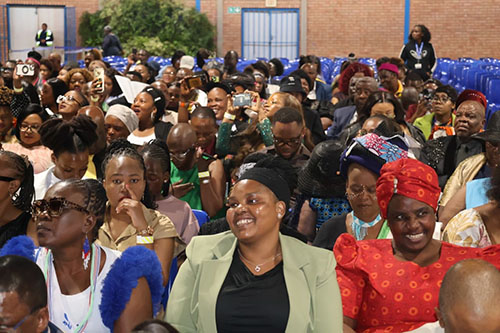
Faculty of ICT celebrates future-ready graduates at Spring Graduation
Academics
9 October 2026
By Kgothatso Monono
The Faculty of Information and Communication Technology (ICT) at the Tshwane University of Technology (TUT) celebrated academic excellence, innovation and resilience as it honoured a new generation of graduates during the University's 2026 Spring Graduation ceremonies at the Ruth First Hall at the Soshanguve South Campus.
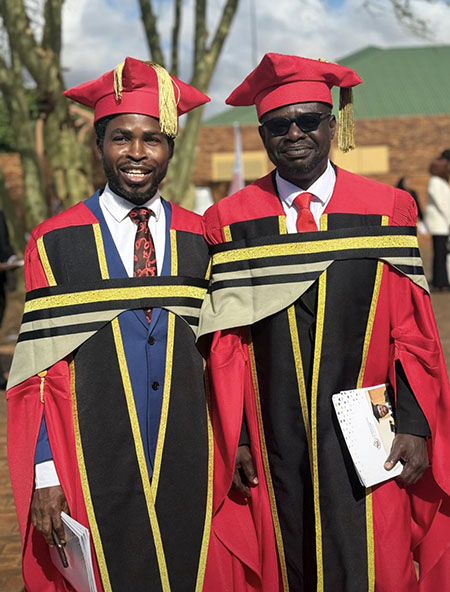 Dr Adebusola Samuel Oluwadare, a Doctor of Computing in Computer Systems Engineering and Dr Adewumi Oluwatoyin Ayo, a Doctor of Computing in Computer Systems Engineering.
The ceremony brought together graduates, their families, academic staff, university leadership and distinguished guests to mark a significant milestone in the lives of students who successfully completed qualifications across the faculty.
Dr Adebusola Samuel Oluwadare, a Doctor of Computing in Computer Systems Engineering and Dr Adewumi Oluwatoyin Ayo, a Doctor of Computing in Computer Systems Engineering.
The ceremony brought together graduates, their families, academic staff, university leadership and distinguished guests to mark a significant milestone in the lives of students who successfully completed qualifications across the faculty.
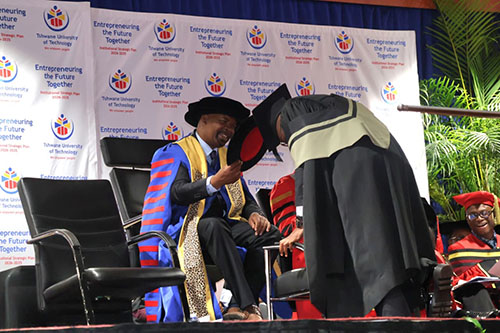
Presiding over the ceremony was TUT Vice-Chancellor and Principal, Prof Tinyiko Maluleke, who served as Acting Chancellor on behalf of Chancellor Dr Gloria Serobe. In his address, Prof Maluleke congratulated graduates on reaching what he described as the pinnacle of their academic journey, acknowledging the resilience, determination and perseverance that enabled them to overcome challenges and achieve their goals.
This year's Spring Graduation ceremonies celebrate more than 1 971 graduates across the University, including 1 667 undergraduate students, 79 postgraduate students below master's level, 154 master's graduates and 71 doctoral graduates.
The Faculty of ICT's graduating cohort represented a diverse range of disciplines, including Computer Science, Computer Systems Engineering, Informatics, Information Technology and Multimedia Computing. Graduates received qualifications spanning national diplomas, undergraduate diplomas, advanced diplomas, postgraduate diplomas, master's degrees and doctoral degrees.
The ceremony also highlighted the achievements of master's graduates whose research addressed pressing challenges in areas such as cybersecurity, renewable energy, electricity infrastructure, healthcare information systems, computer vision, big data, generative artificial intelligence, Internet of Things technologies, agriculture, financial services and digital inclusion. Several master's candidates graduated cum laude, reflecting exceptional academic performance and the Faculty's strong postgraduate research culture.
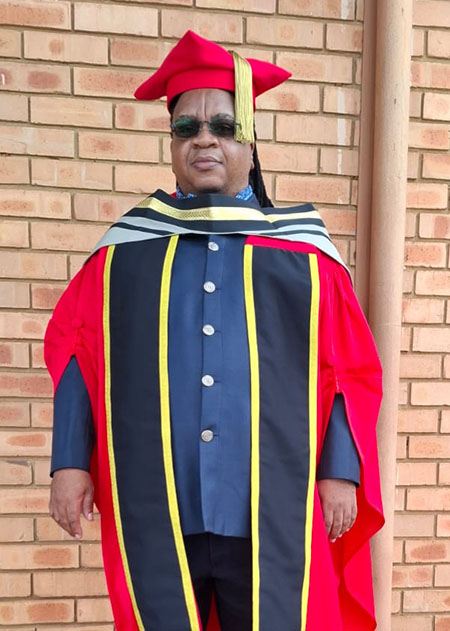 Dr Glen Lehlohonolo Moepi, a Doctor of Computing in Information Technology.
A key highlight of the ceremony was the conferment of doctoral degrees on five distinguished researchers whose work is advancing technological innovation and addressing real-world challenges.
Dr Glen Lehlohonolo Moepi, a Doctor of Computing in Information Technology.
A key highlight of the ceremony was the conferment of doctoral degrees on five distinguished researchers whose work is advancing technological innovation and addressing real-world challenges.
Dr Adebusola Samuel Oluwadare, who earned a Doctor of Computing in Computer Systems Engineering, conducted groundbreaking research on optimised hybrid modelling for atmospheric attenuation and quality-of-service prediction in free-space optical communication systems in South Africa. His study combined deterministic propagation models, principal component analysis and machine-learning techniques to enhance communication system performance.
Dr Olusoji Bidemi Akinrinade, also awarded a Doctor of Computing in Computer Systems Engineering, developed a Kullback-Leibler divergence-based meta-learning algorithm for few-shot skin cancer image classification. His research contributes significantly to medical image analysis, particularly in environments where limited datasets are available.
Dr Adewumi Oluwatoyin Ayo completed doctoral research focusing on the evolutionary-based prediction of rain attenuation time series for satellite communications in South Africa. His work has enhanced understanding of rain attenuation effects on satellite systems and has produced several scholarly outputs, including journal articles, conference papers and a book chapter.
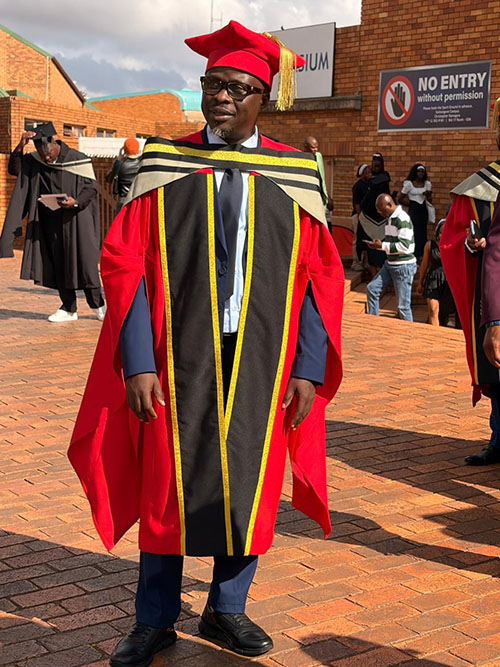 Dr Olusoji Bidemi Akinrinade, a Doctor of Computing in Computer Systems Engineering.
Dr Fortunate Elesa Ntuli received a Doctor of Computing in Computer Systems Engineering for research on interference mitigation in spectrum-sharing networks. She developed an artificial intelligence-driven real-time spectrum optimisation framework that integrates spectrum sensing, LSTM prediction, CNN-based interference detection and deep reinforcement learning. The framework achieved approximately 94% detection accuracy while significantly improving spectrum utilisation and network throughput.
Dr Olusoji Bidemi Akinrinade, a Doctor of Computing in Computer Systems Engineering.
Dr Fortunate Elesa Ntuli received a Doctor of Computing in Computer Systems Engineering for research on interference mitigation in spectrum-sharing networks. She developed an artificial intelligence-driven real-time spectrum optimisation framework that integrates spectrum sensing, LSTM prediction, CNN-based interference detection and deep reinforcement learning. The framework achieved approximately 94% detection accuracy while significantly improving spectrum utilisation and network throughput.
Dr Glen Lehlohonolo Moepi, who earned a Doctor of Computing in Information Technology, developed a bimodal smart surveillance system for real-time farm monitoring. His cost-effective framework integrates gait and facial biometrics to improve the detection and verification of farm assets and individuals. The research resulted in six peer-reviewed publications, with additional journal articles currently under review.
Collectively, the doctoral research showcased during the ceremony highlights the Faculty's growing contribution to solving complex societal challenges through advanced computing, artificial intelligence, telecommunications, healthcare technologies and smart agricultural systems.
The achievements celebrated during the graduation ceremony align closely with TUT's commitment to producing graduates equipped with the knowledge, skills and adaptability required to thrive in the rapidly evolving digital economy.
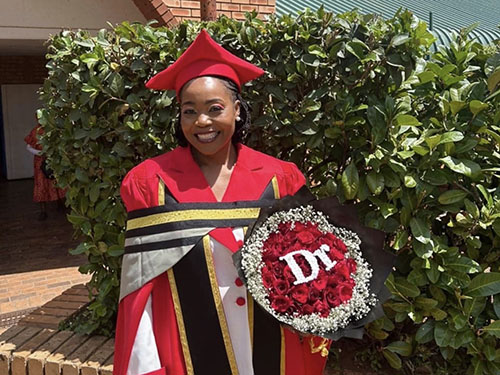 Dr Fortunate Elesa Ntuli, a Doctor of Computing in Computer Systems Engineering.
In his address, Prof Maluleke underscored the values of resilience, excellence, accountability, diversity and stewardship, while highlighting the entrepreneurial mindset that characterises TUT graduates. He encouraged graduates to embrace opportunities within the future world of work and to use their qualifications to create meaningful impact.
Dr Fortunate Elesa Ntuli, a Doctor of Computing in Computer Systems Engineering.
In his address, Prof Maluleke underscored the values of resilience, excellence, accountability, diversity and stewardship, while highlighting the entrepreneurial mindset that characterises TUT graduates. He encouraged graduates to embrace opportunities within the future world of work and to use their qualifications to create meaningful impact.
For the Faculty of ICT, this mission is especially important as technology continues to transform industries, economies and communities. The qualifications awarded and research conducted by graduates demonstrate the powerful role that ICT can play in addressing challenges facing South Africa and the African continent.
As the ceremony concluded, Prof Maluleke reminded graduates that a TUT qualification represents not only a remarkable achievement but also a responsibility to serve society. He challenged them to leverage their expertise to shape a better future, drive innovation, create opportunities, strengthen public services and embody the University's philosophy of "knowledge that works."
The Faculty of ICT congratulates all its graduates on this outstanding achievement and wishes them every success as they apply their knowledge, skills and innovation to advance their professions, communities and society at large.
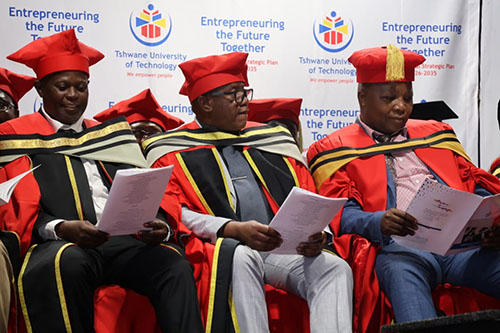
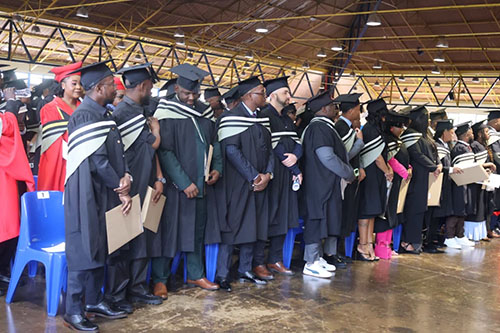 Faculty of ICT Spring Graduates.