Exhibition gives voice to Artivism at GBVF Symposium
Academics
11 August 2026
By Gerrit Bester
Art became a tool for activism in an exhibition featured at the Tshwane University of Technology's (TUT's) 3rd Annual Gender-Based Violence and Femicide (GBVF) Symposium, where artists used creative expression to challenge silence, confront inequality and advocate for social change.
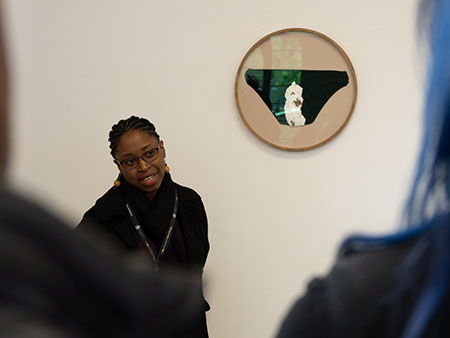 Period Poverty III (2024) by Jessica Philile Mawuiena Foli confronts the realities of period poverty and its impact on the lives and education of women and girls in South Africa.
Presented under the theme Resonant Voices: Artivism Against Silences, the symposium showcased works by artists from TUT and North-West University that explored different dimensions of GBVF, discrimination and resilience.
Period Poverty III (2024) by Jessica Philile Mawuiena Foli confronts the realities of period poverty and its impact on the lives and education of women and girls in South Africa.
Presented under the theme Resonant Voices: Artivism Against Silences, the symposium showcased works by artists from TUT and North-West University that explored different dimensions of GBVF, discrimination and resilience.
The symposium was presented through the Faculty of Arts and Design's Research Niche Area: Artivism as a Tool to Combat Gender-Based Violence(s), in collaboration with Student Affairs and Extracurricular Development, the City of Tshwane and the South African Journal of Art and Architecture (SAJAA).
Among the featured works was Period Poverty III (2024) by Jessica Philile Mawuiena Foli from the Faculty of Arts and Design's Department of Fine and Studio Arts.
The artwork is part of a series that examines the reality of period poverty in South Africa. Many schoolgirls cannot afford menstrual products and, as a result, use materials such as newspapers, rags or socks. This affects school attendance, with many girls missing school because they lack access to menstrual products. The work uses mixed media, created to resemble menstrual blood, to capture the harsh reality many women and young girls face, which is compounded by a lack of access to adequate sanitation facilities.
Also on display was Lull: subversive embroideries and Biblical texts of terror by Annemi Conradie-Chetty from North-West University.
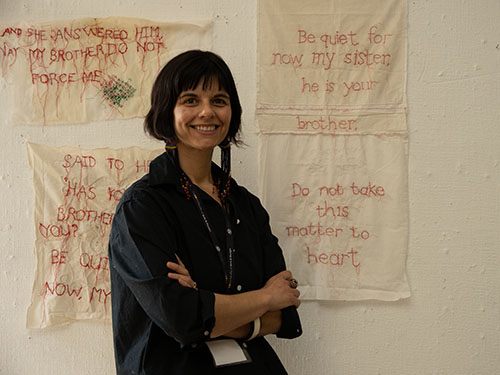 Lull: subversive embroideries and Biblical texts of terror by Annemi Conradie-Chetty uses textiles and embroidery to explore the systemic violence and gendered narratives that continue to perpetuate GBVF.
The artworks use craft associated with women and the home to urge viewers to interrogate the systemic factors that perpetuate GBVF today. Both the fabric and the medium speak to this theme: the fragility of muslin, used to swaddle infants, is contrasted with the cruelty of the narratives. The artist proposes that we question and call for a principled critique of structural violence and the honouring of victims through critical empathy.
Lull: subversive embroideries and Biblical texts of terror by Annemi Conradie-Chetty uses textiles and embroidery to explore the systemic violence and gendered narratives that continue to perpetuate GBVF.
The artworks use craft associated with women and the home to urge viewers to interrogate the systemic factors that perpetuate GBVF today. Both the fabric and the medium speak to this theme: the fragility of muslin, used to swaddle infants, is contrasted with the cruelty of the narratives. The artist proposes that we question and call for a principled critique of structural violence and the honouring of victims through critical empathy.
The exhibition also featured Hidden by Danielle Malherbe from the Faculty of Arts and Design's Department of Fine and Studio Arts.
Hidden is a series of paintings that began as an exploration of the potency of objects in domestic spaces but evolved into an unexpected bringing to light of sensations related to childhood and adolescent experiences of shaming and negation due to being a girl in a misogynistic environment.
The exhibition demonstrated how art can give voice to experiences that are often silenced, encouraging reflection and conversation while reinforcing the symposium's commitment to using artivism to confront GBVF.
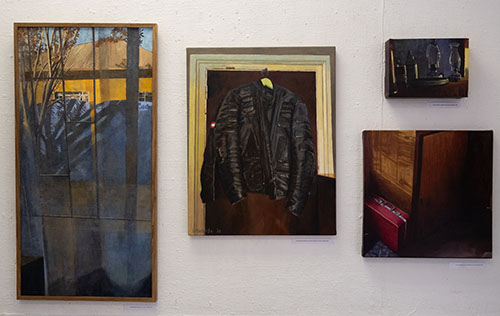
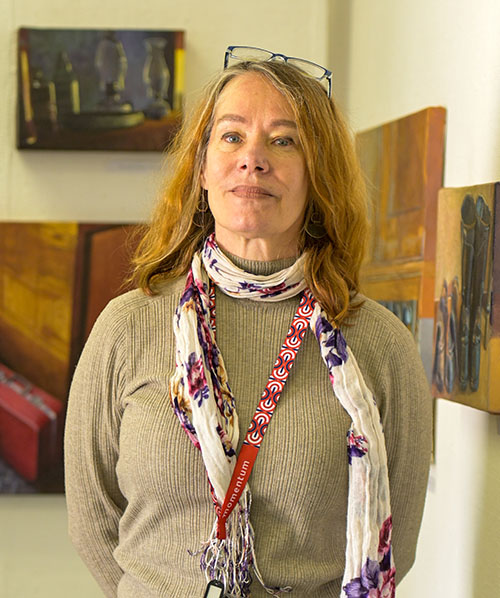
Hidden by Danielle Malherbe reflects on experiences of shame, silence and misogyny, revealing how personal memories can become powerful acts of artistic resistance.
PHOTOS: Siyabonga Shembe and Thabo Dlamini