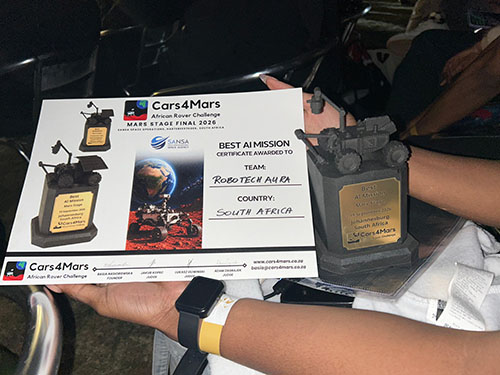
Engineering students triumph at Cars4Mars African Rover Challenge
Academics
8 October 2026
By Mosima Rafapa
The Tshwane University of Technology (TUT) engineering students have once again demonstrated their innovation, technical expertise and problem-solving abilities on the continental stage, by securing two major awards at the prestigious Cars4Mars African Rover Challenge 2026.
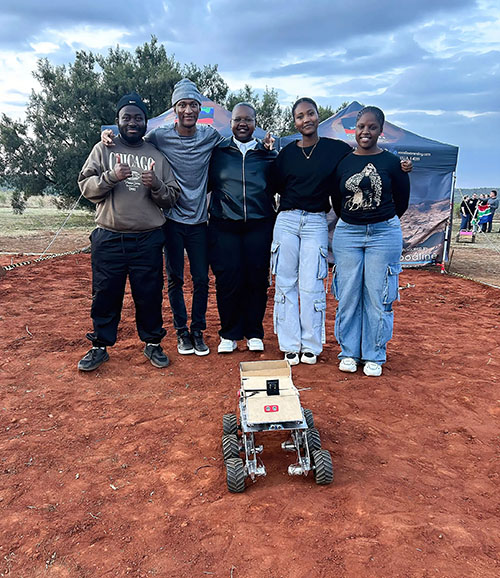 From left, team members for RoboTechAura, Zwothe Mungoni, Kabelo Malele, Ntwanano Bvuma, Rofhiwa Mudau and Sbongakonke Nxumalo, took Best AI Mission at the Cars4Mars African Rover Challenge 2026.
Two teams of final-year students from the Faculty of Engineering and the Built Environment's (FEBE) Department of Mechanical and Mechatronics Engineering emerged victorious in separate categories after successfully navigating demanding Mars rover missions designed to simulate real-world space exploration challenges.
From left, team members for RoboTechAura, Zwothe Mungoni, Kabelo Malele, Ntwanano Bvuma, Rofhiwa Mudau and Sbongakonke Nxumalo, took Best AI Mission at the Cars4Mars African Rover Challenge 2026.
Two teams of final-year students from the Faculty of Engineering and the Built Environment's (FEBE) Department of Mechanical and Mechatronics Engineering emerged victorious in separate categories after successfully navigating demanding Mars rover missions designed to simulate real-world space exploration challenges.
Team Wall-E claimed the Best Traversal Mission Award, while RoboTechAura secured the Best AI Mission Award during the Mars Stage Final held at the South African National Space Agency (SANSA) Space Operations facility in Hartebeesthoek., Gauteng.
The competition brought together approximately 120 students and learners representing 18 teams from South Africa, Kenya and Zimbabwe. These finalists were selected from an initial pool of 100 teams from 11 African countries that entered the challenge earlier this year.
At the centre of the competition was the Mars Yard, a specially constructed obstacle course comprising around 40 tonnes of red sand designed to replicate the harsh and unpredictable conditions of the Martian surface. Teams were required to remotely control their rovers from command stations while completing a series of complex engineering tasks.
For Team Wall-E, the victory marked the culmination of months of dedication, design and testing. Team leader Reabetswe Maila explained that the journey began in February, with team members taking responsibility for various aspects of the rover's development, including coding, electronics and mechanical design using SolidWorks.
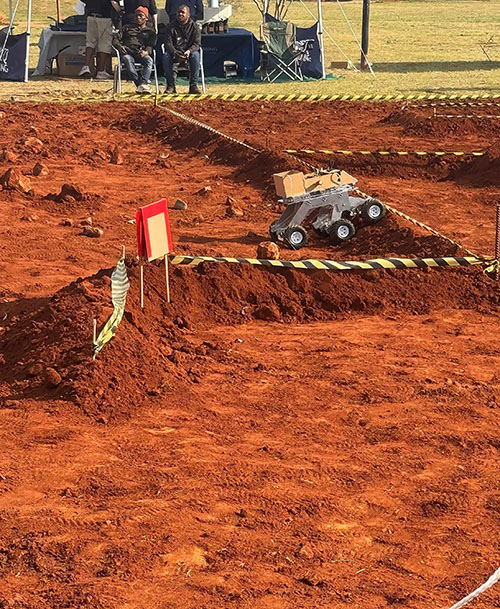 RoboTechAura took Best AI Mission at the Mars Stage Final held on 19 September.
During the Traversal Mission, teams were required to manoeuvre their rovers across rugged terrain while completing assigned tasks, placing their mechanical design, communication systems, control mechanisms and overall reliability under intense scrutiny. "We had to be very resourceful because everything was limited," said Maila, who also participated in the competition last year.
RoboTechAura took Best AI Mission at the Mars Stage Final held on 19 September.
During the Traversal Mission, teams were required to manoeuvre their rovers across rugged terrain while completing assigned tasks, placing their mechanical design, communication systems, control mechanisms and overall reliability under intense scrutiny. "We had to be very resourceful because everything was limited," said Maila, who also participated in the competition last year.
He noted that one of the most valuable lessons was translating classroom theory into a fully functional engineering system. "It was hard but exciting. You are taking something you have mostly learnt in theory and getting the opportunity to bring it to life," he said.
The team's success built on an already impressive performance earlier in the competition, where Wall-E finished second during the online Launch and Final Mars Stage presentations on 15 August.
Meanwhile, RoboTechAura excelled in the demanding AI Autonomous Mission, which required rovers to use onboard cameras, computer vision technology and artificial intelligence algorithms to identify objects based on their shape, colour and location.
Team leader and final-year student Rofhiwa Mudau said the project challenged students to integrate multiple engineering disciplines into a single operational mechatronic system.
Under the guidance of supervisor Johan Benade, team members were responsible for different rover subsystems, including mechanical design, electronics, software development, wireless communication and artificial intelligence technologies, before integrating them into one cohesive platform.
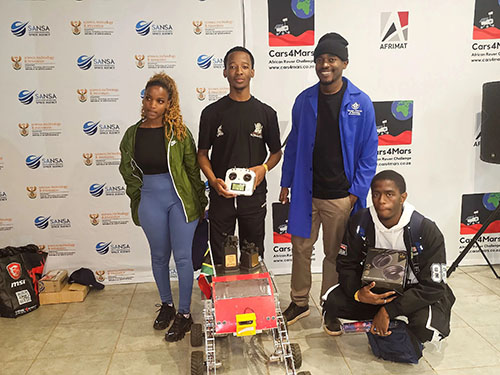 Team Wall-E won Best Traversal Mission at the Cars4Mars African Rover Challenge 2026. From left, Tiego Matseba, Reabetswe Maila, Santi Thole and Mgcini Bashe).
Mudau said limited resources and tight competition deadlines tested the team's resilience and creativity. "We had to make the most of the resources available to us while ensuring that the rover could navigate rough terrain, be controlled remotely and perform autonomous tasks in real time," she said.
Team Wall-E won Best Traversal Mission at the Cars4Mars African Rover Challenge 2026. From left, Tiego Matseba, Reabetswe Maila, Santi Thole and Mgcini Bashe).
Mudau said limited resources and tight competition deadlines tested the team's resilience and creativity. "We had to make the most of the resources available to us while ensuring that the rover could navigate rough terrain, be controlled remotely and perform autonomous tasks in real time," she said.
Their efforts paid off, with the team's advanced AI and computer vision capabilities earning them the Best AI Mission Award. "The competition gave us valuable hands-on experience and taught us how to work as a team and solve problems under pressure," Mudau added.
Reflecting on the teams' achievements, Benade praised the students' determination and adaptability throughout the project. "What impressed me was how the students responded when things did not go according to plan. They had to troubleshoot, adjust and work together under pressure. These are the realities of engineering and seeing them successfully apply their knowledge in that environment was rewarding," he said.
He added that the awards represent months of designing, building, testing and refining innovative engineering solutions. "They worked hard with the resources available to them, and these results show what our students are capable of when they are given an opportunity to design, build and test something themselves."
The Cars4Mars African Rover Challenge is a volunteer-led annual robotics competition that provides university, college and high school students across Africa with an opportunity to develop practical engineering and technological skills while tackling challenges inspired by space exploration.