Employability Forum prepares students for the workplace
Academics
2 November 2026
By Reatlegile Ratlagane
Unemployment remains a significant concern, particularly for graduates who complete their qualifications with the hope of securing employment. Recognising the challenges graduates face when transitioning from university into the workplace, the Tshwane University of Technology’s (TUT) Department of Economics hosted an Industry Engagement and Graduate Employability Forum.
 Keynote speaker Ornica Mukhavhuli.
The engagement, aimed at bridging the gap between academic learning and industry expectations, brought together students and industry representatives to share insights on employment opportunities and to discuss the skills required in the job market.
Acknowledging the high unemployment rate in South Africa, the Executive Dean of the Faculty of Economics and Finance, Prof Polly Mashigo, reassured students that they would be better equipped to navigate the job market by the time they completed their qualifications. She emphasised that the knowledge and practical skills they acquire throughout their studies would prepare them for the demands of the workplace. She highlighted the importance of Work-Integrated Learning (WIL), describing it as a stepping stone that helps students transition from university into the workplace.
“Our students are receiving internships and ultimately permanent employment through WIL. I am appealing to our industry partners and companies that are here to please open their doors to our graduates,” she said.
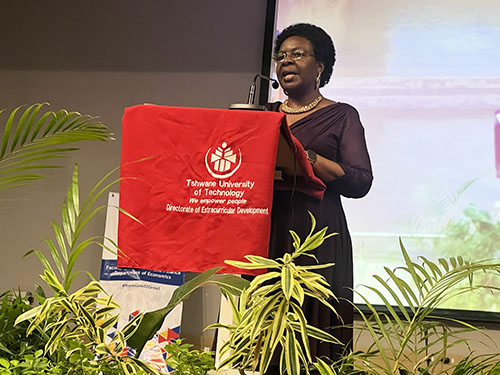 The Executive Dean of the Faculty of Economics and Finance Prof Polly Mashigo.
Prof Mashigo also acknowledged the growing influence of Artificial Intelligence (AI) in financial institutions and other organisations. She cautioned students against becoming dependent on it, emphasising the importance of independent thinking and problem-solving skills.
“AI is reshaping routine tasks in financial institutions and other organisations, but what is particularly important is that you must possess the ability to interpret and question data. Do not only rely on AI. You must be a self-discoverer and a problem-solver,” she noted.
She further encouraged students to look beyond employment opportunities and explore how they could use their knowledge and skills to create their own opportunities.
The Head of the Department of Economics, Prof Mulatu Zerihun, pointed out that many graduates struggle to secure employment because they lack practical work experience, emphasising the role of WIL in helping students gain workplace experience as they complete their qualifications.
“Students are denied job opportunities because of a lack of work experience. So, TUT introduced Work-Integrated Learning, which gives students a platform to acquire experience while they are still studying,” he said.
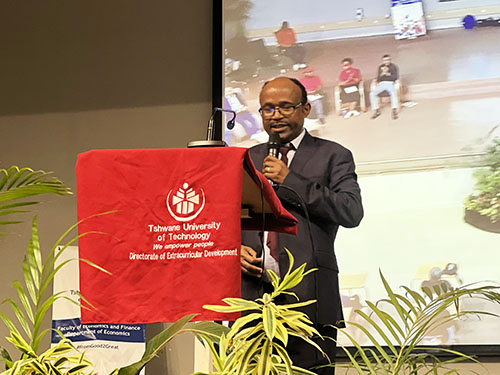 Department of Economics HoD Prof Mulate Zerihun.
He further emphasised that securing a work opportunity is only the beginning, as graduates must demonstrate skills and character that needed to secure permanent employment. He encouraged students to build good professional relationships, noting that their determination and how they work with others could have a huge influence to opening doors to further opportunities.
Delivering the keynote address, Ornica Mukhavhuli, Group CEO at Sensation Global Holdings and founder of African Skills Academy and African Implementation Management Services, shared her experience after completing her qualification. She emphasised that her positive attitude has always opened opportunities for her. She encouraged students to approach every opportunity with enthusiasm and understand that their attitude, willingness to learn and determination can open doors to new possibilities.
She encouraged students to visit the “To the Power of x²” website, create profiles and apply for available internship opportunities. The government initiative aims to create 20 000 employment opportunities for young graduates.
She further urged students to go beyond their assigned responsibilities and exceed expectations during their first 90 days of employment. She stressed that the first three months are crucial in establishing a graduate’s professional reputation.
“Treat your first 90 days at work as your final exam, because we are watching. If you fail to impress an employer in 90 days, then you are already classified,” she said.
The engagement concluded with a panel discussion with representatives from various industry stakeholders, including KPMG, Discovery, Absa and Rethinking Economics for Africa. Under the theme “Skills for a Changing Economy: Preparing Economics Graduates for the World of Work,” the panellists shared insights into the demands of the job market and the skills graduates need to secure employment. The discussion explored how graduates can adapt to changing industry expectations and emphasised the importance of interpersonal skills in securing employment.