Doctoral student flies SA flag at international quantum computing school
Academics
10 November 2026
By Kgothatso Monono
A doctoral student from the Tshwane University of Technology’s (TUT) Faculty of Information and Communication Technology (FoICT) is putting South African research on the global stage after being selected as the country’s sole representative at the prestigious Thai School of Quantum Computing in Thailand.
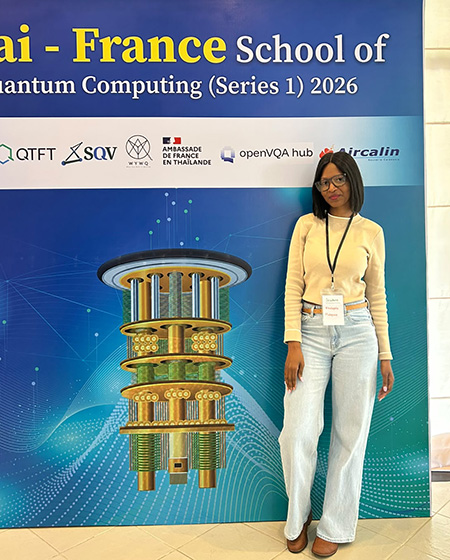 Kholofelo Halefose, a Doctor of Computing student in the Department of Information Technology (IT).
Kholofelo Halefose, a Doctor of Computing student in the Department of Information Technology (IT), was among only 15 international participants selected to attend the highly competitive programme at Lilawalai Resort in Khao Yai, Nakhon Ratchasima. She was the only participant selected from South Africa and the African continent, underscoring the growing potential of TUT’s postgraduate research to contribute to emerging fields of global technology.
The school attracted approximately 150 applications, with only 30 participants ultimately selected, comprising 15 students from Thailand and 15 international participants. Kholofelo’s selection placed her among a diverse group of emerging researchers and offered her an opportunity to engage with international experts while gaining valuable exposure to advances in quantum technologies.
Organised by What You Want in Quantum (WYW) and QTFT, with Siam Quantum Valley as co-organiser, the programme was supported by the Institute for Fundamental Study at Naresuan University and the Embassy of France in Thailand. Selected participants received full financial support covering registration, accommodation, meals and local transportation.
The week-long intensive programme introduced bachelor’s, master’s and early-stage doctoral students to the rapidly evolving field of quantum computing. Participants attended lectures presented by international experts from France, India, Vietnam, Germany, Thailand and Australia, exploring both fundamental concepts and practical applications of quantum technologies.
The curriculum covered quantum mechanics, qubits, quantum algorithms, quantum software, quantum error correction, quantum simulation and optimisation, as well as the fundamentals of post-quantum cryptography.
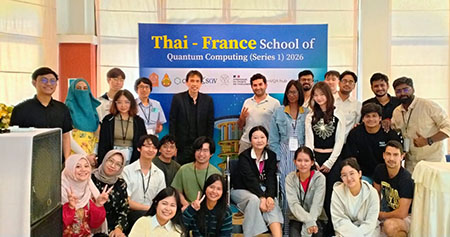 Practical tutorials complemented the theoretical sessions, giving participants hands-on experience with platforms and tools such as IBM Quantum, Qaptiva/Bull and the OpenVQE/OpenVQA packages. Collaborative mini-projects further encouraged knowledge sharing and problem-solving among students from different countries.
Reflecting on the experience, Kholofelo said the programme significantly strengthened her understanding of quantum computing by combining theoretical knowledge with practical exposure and international collaboration. “The programme strengthened my understanding of quantum computing, from fundamental concepts such as qubits and quantum gates to quantum algorithms and error correction. It also provided practical experience with real quantum computing platforms and open-source software, while expanding my understanding of post-quantum cryptography and its importance in securing critical infrastructure against future quantum threats,” she said.
Kholofelo believes the knowledge gained in Thailand presents an important opportunity to bridge academic research and practical industry needs. Through her doctoral research and industry involvement, she hopes to raise awareness of quantum technologies, identify opportunities for their application in South African industries and support organisations as they prepare for emerging cybersecurity challenges. She believes South Africa must begin developing the skills and research capacity required to harness the benefits of quantum technologies while simultaneously preparing for the security risks they may introduce.
Her participation also highlights the importance of strengthening collaboration between universities and industry to ensure that expertise in emerging technologies translates into meaningful, real-world solutions. She plans to share the knowledge and experience gained through talks, workshops and collaborative initiatives with fellow students and staff at TUT.
For the FoICT, Kholofelo’s achievement reinforces the importance of equipping postgraduate students with advanced knowledge, research capabilities and international exposure to participate meaningfully in rapidly evolving technological fields.