Dean’s Seminar challenges Researchers to turn knowledge into impact
Academics
23 October 2026
The Faculty of Management Sciences at the Tshwane University of Technology TUT) brought academia and industry together at its Dean’s Seminar to explore a question increasingly central to research: How can academic knowledge move beyond publication and make a meaningful difference in industry and society?
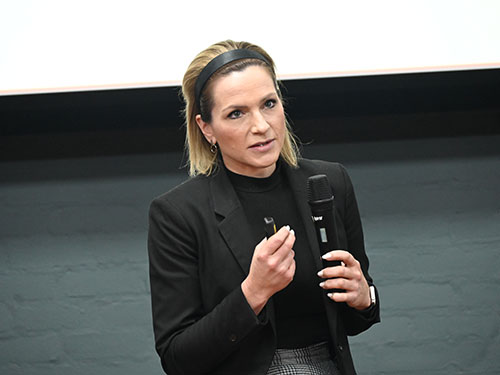 Jorja Wilkins, General Manager of Future Media and Sustainability at Provantage Media Group delivering her address.
Hosted by the Department of Marketing, Supply Chain and Sport Management under the theme “Making Research Matter: From Academic Impact to Industry Relevance,” the seminar highlighted the need for stronger collaboration between researchers and industry practitioners.
Opening the seminar, Sharol Mkhomazi, Acting Executive Dean, emphasised that academics' responsibilities extend beyond publishing and generating knowledge. “Research should address meaningful problems, inform practice, influence decision-making and contribute to society and industry. It should not only be published, but it should also make a difference,” Sharol told participants.
The seminar featured an industry presentation by Jorja Wilkins, General Manager of Future Media and Sustainability at Provantage Media Group, alongside a research-focused presentation by Professor Rick Wilson of Texas State University in the United States.
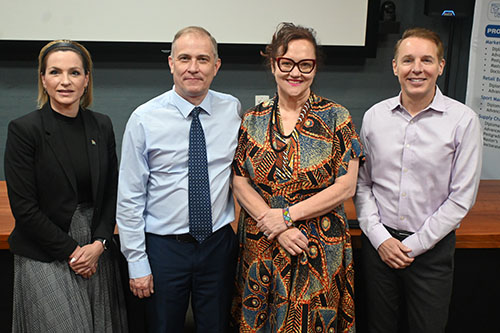 At the Seminar from left are: Jorja Wilkins, Prof Anton Drotsky, Prof Therese Roux and Prof Rick Wilson.
In her presentation, “The Distance Between Knowing and Doing” Jorja explored the gap between producing knowledge and translating it into decisions and action. She argued that while society has unprecedented access to knowledge, knowing something and acting on it remains very different.
She illustrated research impact as a journey from a question to evidence, publication, practitioner engagement, decision-making, implementation and, ultimately, real-world consequences. One challenge, she suggested, lies in the space between academia and industry, where research findings must be translated into practical decisions.
Her message was particularly relevant to postgraduate researchers. She encouraged them to engage with practitioners before finalising their research designs and to consider whether their research questions matter to the people who may ultimately have to act on their findings.
At the same time, she cautioned against confusing accessibility with weaker research. Her message was clear: research does not need to be simpler, but it needs to be sturdier, maintaining methodological rigour, while being communicating in ways industry can understand and use.
Professor Rick Wilson's presentation,“From Sign to Synthesis: My 20-Year Journey with Out-of-Home Advertising Research,” demonstrated how questions emerging from industry can develop into a sustained academic research programme.
Drawing on his extensive work in out-of-home advertising, he explained that many of his research questions begin with practical industry problems before being connected to relevant academic theory and appropriate methodologies.
His research has examined issues ranging from advertising creativity and location to consumer attention, environmental context and emerging developments such as programmatic and fake out-of-home advertising. He also highlighted opportunities presented by social and mobile integration and big data.
An important lesson from his research journey was the need for academics to look beyond the traditional boundaries of their disciplines. Professor Wilson explained that valuable knowledge about out-of-home advertising can also be found in fields such as engineering, computing, medicine and urban studies, even when researchers in those areas use different terminology.
The message resonated during the closing discussion, where participants reflected on the need for researchers and postgraduate students to broaden their literature searches beyond journals directly associated with their disciplines.
A recurring theme throughout the seminar was the importance of genuine two-way collaboration. Academia can offer independent evidence, rigorous methods, long-term thinking and questions that industry may be too close to recognise, while industry can provide researchers with access to real environments, real data and current problems that require solutions.
The discussion also acknowledged a significant challenge: time. Industry often needs answers quickly, while rigorous academic research, including ethical processes, data collection, analysis, peer review and publication, can take considerably longer. The speakers and participants therefore explored how closer partnerships could help make research more responsive without sacrificing academic rigour.
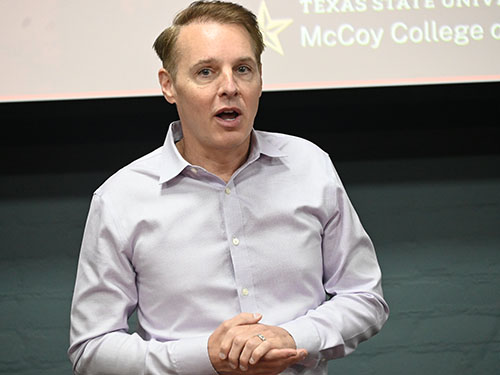 Professor Rick Wilson sharing his 20-year journey with out of home advertising research.
The seminar was also made possible through the support of Dr Anton Drotsky, Head of the Department of Marketing, Supply Chain and Sport Management, who supported the initiative and facilitated a significant portion of the funding for the visit. Professor Thérèse Roux, an NRF-rated researcher specialising in out-of-home advertising and a co-author with Prof Wilson, initiated and coordinated his week-long visit to South Africa in October 2026.
Looking ahead, the Department of Marketing, Supply Chain and Sport Management looks forward to strengthening its ongoing collaboration with Professor Wilson and Provantage Media Group, creating further opportunities for joint research, knowledge sharing and meaningful engagement between academia and industry
Ultimately, the seminar reinforced a simple but powerful principle: the value of research lies not only in generating knowledge, but also in ensuring that knowledge reaches the people who can use it.
The message was clear: research matters most when knowledge moves beyond academic publications and makes a difference in practice.