Artivism meets humanity at TUT conference
Academics
5 October 2026
By Gerrit Bester
At the TUT Artivism Conference 2026: Reimagining Futures, photographer Vishern Debiky invites audiences to reconsider what they think they know about homelessness, dignity and belonging in South Africa's urban spaces.
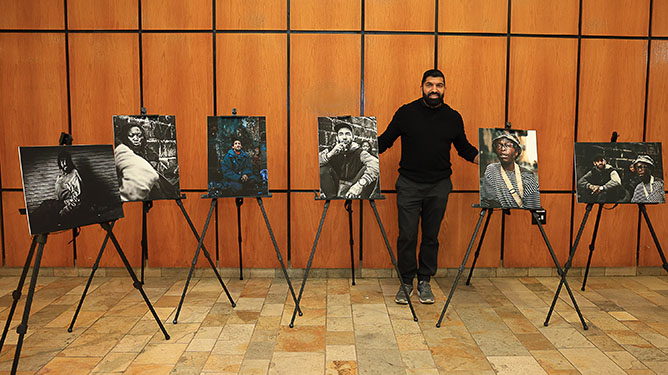 Photographer Vishern Debiky with images from The Promised Land: Egoli: The City of Gold, a portrait series that invites audiences to look beyond labels and listen to the stories behind every face.
Through his exhibition, The Promised Land: Egoli: The City of Gold, Debiky turns his lens towards Johannesburg's inner city. Yet his intention is not to document poverty. Instead, he seeks to reveal the humanity often concealed behind the label of homelessness.
Photographer Vishern Debiky with images from The Promised Land: Egoli: The City of Gold, a portrait series that invites audiences to look beyond labels and listen to the stories behind every face.
Through his exhibition, The Promised Land: Egoli: The City of Gold, Debiky turns his lens towards Johannesburg's inner city. Yet his intention is not to document poverty. Instead, he seeks to reveal the humanity often concealed behind the label of homelessness.
His fascination with Johannesburg's inner city began with its reputation.
"I always knew it had a problem of homelessness and it was one of the most feared places to drive through, especially at night," he explains. "I had a feeling there were people behind this homelessness.”
What started as an attempt to photograph homelessness soon evolved into something far more personal. Debiky realised that meaningful engagement required putting the camera aside and listening first.
In his own family, there is a long-standing practice of providing food to people experiencing homelessness. Over time, however, he began to feel that practical support alone was not enough.
"I realised sometimes people need more than food. They need conversations," he says. "When you start listening, you realise how fragile life is and how quickly it can change."
Those conversations revealed stories that challenged common assumptions. Among those he met was a man who lost family members during the Covid-19 pandemic, could no longer afford housing and eventually found himself living on the streets while dealing with an HIV diagnosis. Encounters such as these transformed Debiky's approach.
"I stopped photographing homelessness and started photographing people."
For Debiky, listening became central to the creative process.
"It's so easy to hide behind the lens and not understand or listen to the subject in front of you," he says. "Listening gives you more understanding. Then you're taking the shot with intention."
Each portrait in the exhibition tells a story. While ten portraits are featured in the exhibition, the project itself encompasses the lives and stories of fourteen individuals whose experiences shaped Debiky's understanding of Johannesburg and its people.
This emphasis on relationship rather than representation is what gives The Promised Land its distinctive power. Rather than reducing people to their circumstances, the exhibition foregrounds dignity, agency and individuality. Fathers and mothers, mechanics and artists, dreamers and survivors emerge from behind the stereotypes that often define public perceptions of homelessness.
The approach resonates strongly with the conference theme, Reimagining Futures. Debiky's work challenges audiences to imagine different ways of seeing. It encourages deeper conversations about social justice, urban inequality and human connection, while reminding viewers that meaningful change begins with recognising the humanity of others.
For Debiky, this is also where the project's artivist dimension lies.
"These homeless people need other individuals to stand up for them," he says. "They are the silent, forgotten people. I hope the exhibition exposes what these human beings have to go through."
The exhibition also raises important ethical questions about photography and representation. Debiky believes photographers have a responsibility to engage respectfully with vulnerable communities and to seek permission wherever possible.
"Photographers should do the ethical thing. It's almost like a north star," he explains. "These pictures are not for financial gain.”
As a first-time exhibitor, he has been struck by how audiences engage with the portraits.
"People stare at the images and I wonder what they are thinking," he says. "A common reaction is that these portraits talk to them."
That response, he believes, reflects the deeper purpose of the work: creating moments of reflection that challenge quick judgments and easy assumptions.
Ultimately, The Promised Land: Egoli: The City of Gold demonstrates how photography can become an act of empathy, advocacy and social engagement. By placing relationships at the centre of the creative process, Debiky creates space for stories that might otherwise remain unheard.
If viewers leave with one message, he hopes it is a simple but powerful one:
"Everyone has a story to tell. Listen to it before you judge."