AI as collaborator takes centre stage at TUT Arts Festival exhibition
Academics
10 September 2026
By Gerrit Bester
Artificial Intelligence (AI) is increasingly shaping conversations across the creative industries. Against this backdrop, the Department of Visual Communication at the Tshwane University of Technology (TUT) is inviting audiences to engage critically with the technology through a thought-provoking exhibition at the TUT Arts Festival.
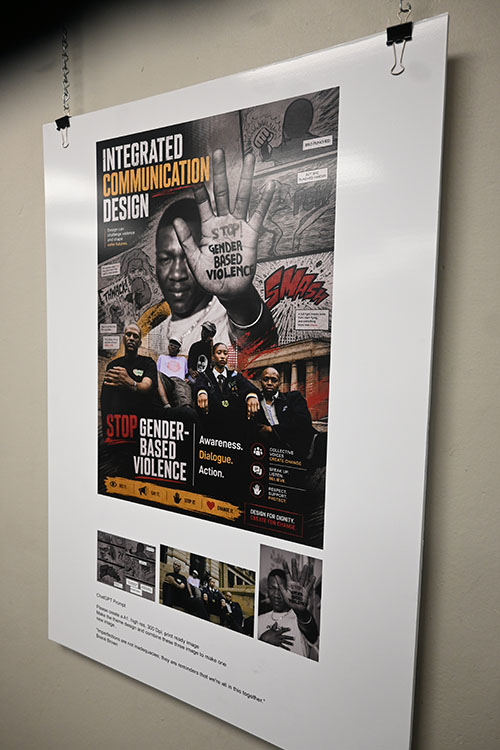 AI as Collaborator – An Invitation to Look Closely is one of the exhibitions currently featured at the TUT Arts Festival hosted until Saturday, 12 September.
Rather than avoiding AI or viewing it as a threat, the project uses the technology as a starting point for discussion and experimentation. It explores AI's possibilities, limitations and the important questions it raises for creative practitioners.
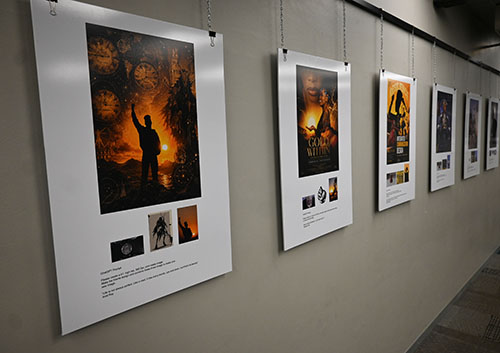
AI as Collaborator – An Invitation to Look Closely is one of the exhibitions currently featured at the TUT Arts Festival hosted until Saturday, 12 September.
Rather than avoiding AI or viewing it as a threat, the project uses the technology as a starting point for discussion and experimentation. It explores AI's possibilities, limitations and the important questions it raises for creative practitioners.
Particularly relevant amid ongoing debates about AI-generated imagery, the exhibition aligns with the Faculty of Arts and Design's 2026 theme, Collaboration, by examining what happens when AI enters the creative process, not as the author, but as a creative partner.
One of the project's most revealing findings was the extent to which human input shaped the final outcomes. According to organisers, some posters required more than 20 prompt refinements before satisfactory results were achieved, highlighting that AI remains dependent on human direction, judgement and expertise.
The display brings together student work from Integrated Communication Design (ICD), Motion Picture Production and Commercial Photography. Images and film stills produced by students from these programmes were supplied to an AI image generator, accompanied by deliberately simple prompts instructing the software to combine them into poster designs.
Each poster features the original images, the prompt used, the AI-generated outcome and a quotation selected by the person who created the prompt. Presented side by side, these elements make the creative process visible, allowing viewers to compare source material with the final result and consider how human decisions shape AI-generated content.
Rather than presenting polished masterpieces, the posters are displayed as experiments. Visitors are encouraged to reflect on what may have been gained, lost or transformed through the process. While some works reveal new possibilities, unexpected connections and opportunities to enhance creative workflows, others expose shortcomings such as image distortion, design flaws, altered narratives, misinterpretations and the potential loss of individual artistic voices.
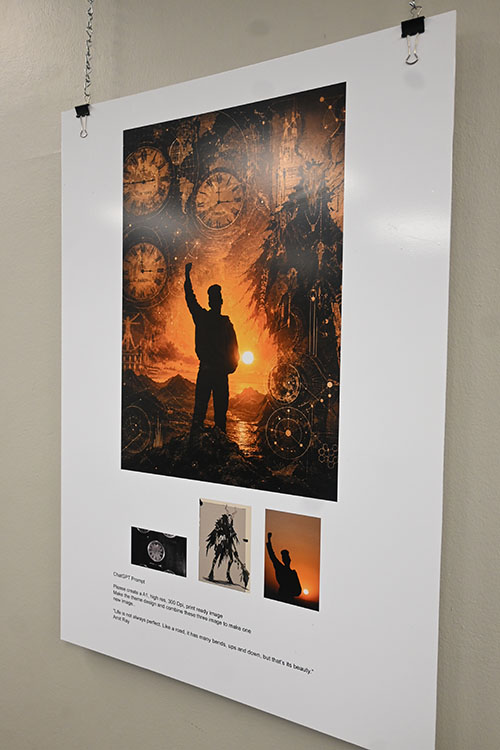 Importantly, the project does not ask whether AI will replace designers. Instead, it considers how creative practitioners can work critically, ethically and responsibly with emerging technologies while retaining the human insight and judgement that underpin meaningful visual communication.
Shantha Steenkamp from the Integrated Communication Design programme, who was involved in the project, said the outcomes depended heavily on the quality of the prompts. "AI still depends on a designer who understands the principles of visual communication and can guide the process effectively," she said.
On a lighter note, Steenkamp revealed that she often included "please" and "thank you" when prompting AI systems. Curious about whether South Africans are generally more polite when interacting with AI, she posed the question to the technology itself.
"The response suggested that, while there are no statistics available, South Africans are often perceived as courteous communicators," she said.
Audience reactions have been equally revealing.
"Many viewers describe the work as both scary and fascinating," said Steenkamp.
As part of the project, AI was even asked for its own assessment of the initiative. Unsurprisingly, the feedback was overwhelmingly positive.
PHOTOS: Gerrit Bester